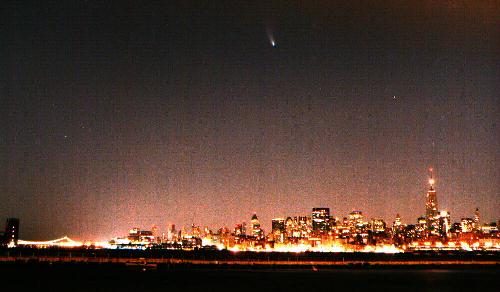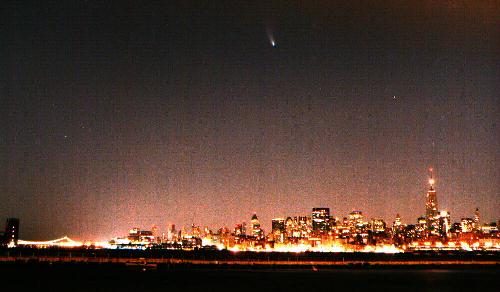
Undaunted by the artificial glow from one of the most famous urban skylines on Earth, comet Hale-Bopp shines above the city of New York, USA. Photographed on March 23rd, this view from New Jersey shows the Hudson River in the foreground, the Empire State Building at the right, the George Washington Bridge at the left, and the comet with a visible tail above. The comet lies at a distance of about 120 million miles from New York. As bright as this comet has turned out to be, it might have been even brighter. On May 6, Hale-Bopp's orbit will take it within about 10 million miles of the point in the Earth's orbit which was occupied by planet Earth itself in early January. If the comet had also reached this point in January, it would have come almost as close to Earth as comet Hyakutake did last year. At that distance, Hale-Bopp might have been 100 times brighter than it is now, reaching -5th or -6th magnitude!
Sin dejarse intimidar por el resplandor artificial de uno de los horizontes urbanos más famosos de la Tierra, el cometa Hale-Bopp brilla sobre la ciudad de Nueva York, EE. UU. Fotografiado el 23 de marzo, esta vista desde Nueva Jersey muestra el río Hudson en primer plano, el Empire State Building a la derecha, el puente George Washington a la izquierda, y el cometa con una cola visible en lo alto. El cometa se encuentra a una distancia de aproximadamente 120 millones de millas de Nueva York. A pesar de lo brillante que ha resultado ser este cometa, podría haber sido aún más brillante. El 6 de mayo, la órbita de Hale-Bopp lo llevará a aproximadamente 10 millones de millas del punto en la órbita de la Tierra que fue ocupado por nuestro planeta a principios de enero. Si el cometa también hubiera alcanzado ese punto en enero, se habría acercado casi tanto a la Tierra como lo hizo el cometa Hyakutake el año pasado. A esa distancia, Hale-Bopp podría haber sido 100 veces más brillante de lo que es ahora, ¡alcanzando una magnitud de -5 o -6!