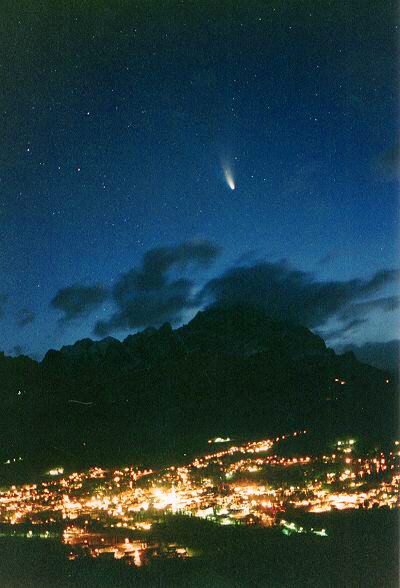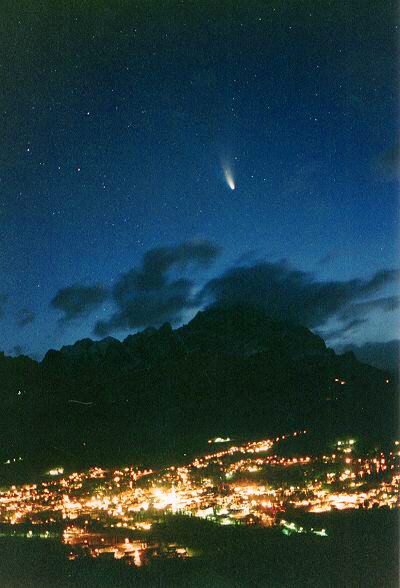
It has been suggested that Comet Hale-Bopp will become the most viewed comet in Human history. Presently, for denizens of the Earth's northern hemisphere, this bright comet is certainly a lovely and inspiring sight -- visible here crowning the sky above Cortina d'Ampezzo, Italy on March 20. Based on orbital calculations, this comet's last passage through the inner Solar System was approximately 4,200 years ago. Principally because of changes caused by the gravitational influence of Jupiter, Hale-Bopp should pass this way again in a mere 2,380 years. Comets come from the outer reaches of the Solar System where they reside, frozen and preserved. Astronomers analyzing their structure and composition as comets swing near the Sun seek a glimpse of the conditions during the Solar System's formative years.
Se ha sugerido que el cometa Hale-Bopp se convertirá en el cometa más observado en la historia de la humanidad. En la actualidad, para los habitantes del hemisferio norte de la Tierra, este brillante cometa es sin duda un espectáculo hermoso e inspirador — visible aquí coronando el cielo sobre Cortina d'Ampezzo, Italia, el 20 de marzo. Basándose en cálculos orbitales, el último paso de este cometa por el Sistema Solar interior ocurrió hace aproximadamente 4.200 años. Principalmente debido a los cambios provocados por la influencia gravitacional de Júpiter, el Hale-Bopp debería pasar nuevamente por aquí en tan solo 2.380 años. Los cometas provienen de las regiones más alejadas del Sistema Solar, donde residen congelados y preservados. Los astrónomos que analizan su estructura y composición mientras los cometas se acercan al Sol buscan vislumbrar las condiciones que imperaban durante los años formativos del Sistema Solar.