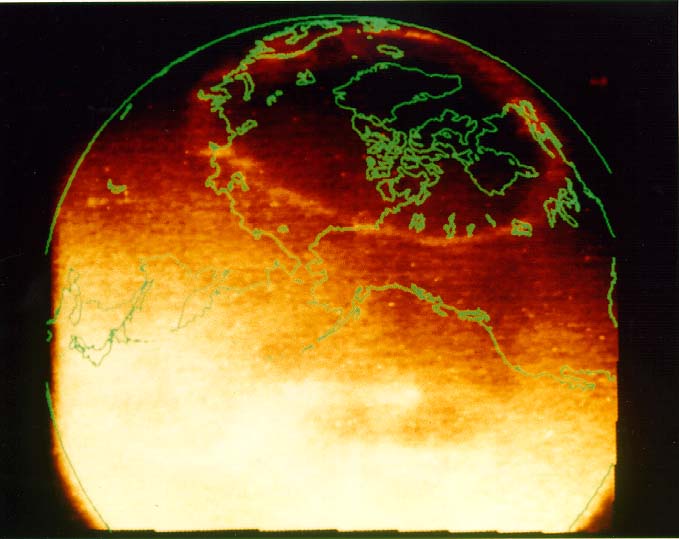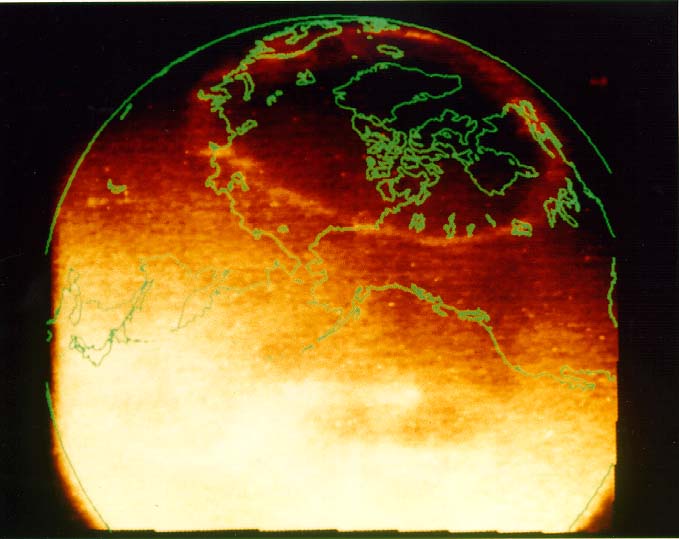
Aurora frequently make complete rings around a pole of the Earth. This particular "crown", visible in orange near the top of this image, was taken by the orbiting Polar spacecraft about one year ago and released by NASA last month. A complete auroral oval is normally hard to photograph because part of it usually occurs over a brightly sunlit portion of the Earth. Polar's Earth Camera, however, can be programmed to filter out all but a certain type of ultraviolet light. In this "color", atmospheric oxygen can glow brighter than reflected sunlight. People with normal eyesight living near the Great Lakes in North America would have been able to see this aurora, were it not daytime!
Las auroras frecuentemente forman anillos completos alrededor de un polo de la Tierra. Esta particular "corona", visible en naranja cerca de la parte superior de esta imagen, fue captada por la nave espacial Polar en órbita hace aproximadamente un año y publicada por la NASA el mes pasado. Un óvalo auroral completo normalmente es difícil de fotografiar porque parte de él suele ocurrir sobre una porción de la Tierra fuertemente iluminada por el Sol. La Cámara Terrestre de Polar, sin embargo, puede programarse para filtrar todo excepto un tipo específico de luz ultravioleta. En este "color", el oxígeno atmosférico puede brillar con mayor intensidad que la luz solar reflejada. Las personas con visión normal que viven cerca de los Grandes Lagos en América del Norte habrían podido ver esta aurora, ¡de no haber sido de día!