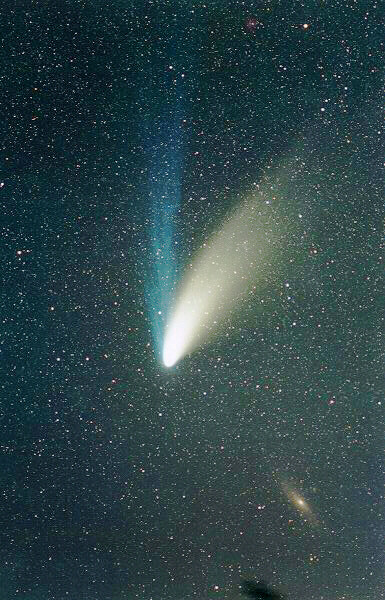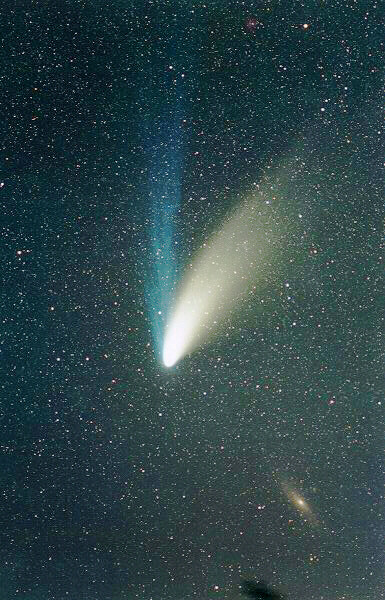
Which is closer: the comet or the galaxy? Answer: the comet. In its trek through the inner Solar System, Comet Hale-Bopp has passed nearly in front of the Andromeda Galaxy (M31), seen on the lower left. At the time of this picture, March 27th, Comet Hale-Bopp was about 10 light-minutes from the Earth, while M31 remained about 3 million light-years distant. By contrast, light can cross the Earth in about 1/20th of a second, and light takes about one second to reach Earth's Moon. Comet Hale-Bopp is one of the largest comets ever recorded, and although its' nucleus has never been photographed, it is estimated from brightness and spin measurements to be about 40 kilometers across. In contrast, Comet Halley in 1987 was measured to be 15 km, and Comet Hyakutake in 1996 was estimated to be no more than 10 km.
¿Cuál está más cerca: el cometa o la galaxia? Respuesta: el cometa. En su travesía por el Sistema Solar interior, el Cometa Hale-Bopp ha pasado casi frente a la Galaxia de Andrómeda (M31), visible en la parte inferior izquierda. En el momento de esta imagen, el 27 de marzo, el Cometa Hale-Bopp se encontraba a unos 10 minutos-luz de la Tierra, mientras que M31 permanecía a unos 3 millones de años-luz de distancia. En comparación, la luz puede atravesar la Tierra en aproximadamente 1/20 de segundo, y la luz tarda alrededor de un segundo en llegar a la Luna. El Cometa Hale-Bopp es uno de los cometas más grandes jamás registrados y, aunque su núcleo nunca ha sido fotografiado, se estima, a partir de mediciones de brillo y rotación, que mide aproximadamente 40 kilómetros de diámetro. En contraste, el Cometa Halley en 1987 fue medido en 15 km, y el Cometa Hyakutake en 1996 fue estimado en no más de 10 km.