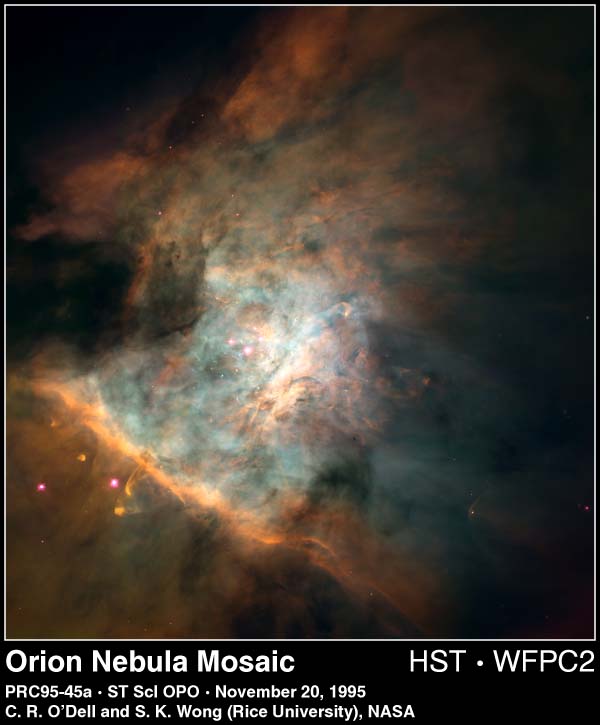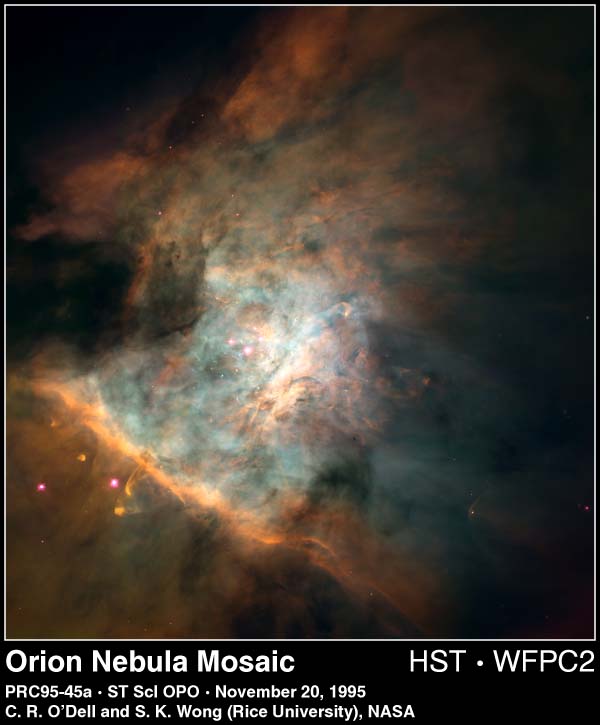
The Great Nebula in Orion, an immense, nearby starbirth region, is probably the most famous of all astronomical nebulae. Here, 15 pictures from the Hubble Space Telescope have been mosaicked to cover the inner 2.5 light years of the nebula and illustrate its diverse nature. In addition to housing a bright open cluster of stars known as the Trapezium, the Orion Nebula contains many stellar nurseries. These nurseries contain hydrogen gas, hot young stars, proplyds, and stellar jets spewing material at high speeds. Most of the filamentary structures visible in this image are actually shock waves - fronts where fast moving material encounters slow moving gas. Shocks are particularly apparent near the bright stars in the lower left of the picture. The Orion Nebula is about 1500 light years distant, located in the same spiral arm of our Galaxy as the Sun.
La Gran Nebulosa de Orión, una inmensa y cercana región de formación estelar, es probablemente la más famosa de todas las nebulosas astronómicas. Aquí, 15 imágenes del Telescopio Espacial Hubble han sido combinadas en mosaico para cubrir los 2,5 años luz interiores de la nebulosa e ilustrar su diversa naturaleza. Además de albergar un brillante cúmulo abierto de estrellas conocido como el Trapecio, la Nebulosa de Orión contiene numerosas guarderías estelares. Estas guarderías contienen gas hidrógeno, jóvenes estrellas calientes, próplidos y chorros estelares que expulsan material a altas velocidades. La mayoría de las estructuras filamentosas visibles en esta imagen son en realidad ondas de choque: frentes donde el material en movimiento rápido encuentra gas en movimiento lento. Los choques son particularmente evidentes cerca de las estrellas brillantes en la parte inferior izquierda de la imagen. La Nebulosa de Orión se encuentra a unos 1500 años luz de distancia, ubicada en el mismo brazo espiral de nuestra Galaxia que el Sol.