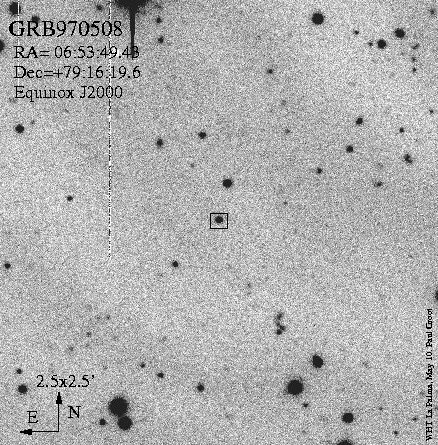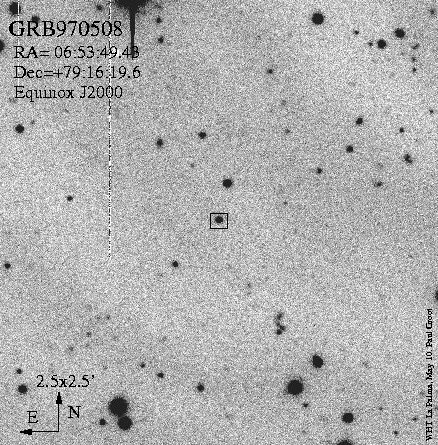
The GRB distance scale controversy may have just ended with a flash. Gamma Ray Bursts (GRBs) are powerful explosions occurring in seemingly random positions on the sky. They are so featureless and so poorly resolved, however, that their distances could not be determined. Last Thursday, May 8th, the orbiting Beppo-Sax Satellite detected and precisely located a GRB (GRB970508), quickly relaying its position to astronomers. Within hours, many of the world's most powerful telescopes were re-pointed in the direction of the new GRB. There they found a faint but variable optical source: a potential counterpart to the gamma-ray burst that was getting brighter. Most importantly, continued scrutiny showed that this optical transient had absorption lines with a redshift of about 0.8 - the distance scale of galaxies and quasars. If this source and GRB970508 are related, the GRB itself must be many billions of light-years away and the 30-year controversy on the distance scale to GRBs will draw dramatically to a close. GRBs could move from the realm of astronomical mystery to useful beacons of the early universe. Above is a "negative" image of the GRB970508 field, located near the north celestial pole, taken hours after the initial flash of gamma rays. The faint optical transient source is inside the box. North is up and the image is 2.5 arcminutes across (about a tenth the size of the full moon).
La controversia sobre la escala de distancias de los GRB podría haber llegado a su fin con un destello. Los Destellos de Rayos Gamma (GRBs, por sus siglas en inglés) son explosiones de gran energía que ocurren en posiciones aparentemente aleatorias del cielo. Sin embargo, son tan poco definidos y están tan pobremente resueltos que no ha sido posible determinar sus distancias. El pasado jueves 8 de mayo, el satélite en órbita Beppo-Sax detectó y localizó con precisión un GRB (GRB970508), transmitiendo rápidamente su posición a los astrónomos. En cuestión de horas, muchos de los telescopios más potentes del mundo fueron reorientados hacia la dirección del nuevo GRB. Allí encontraron una fuente óptica débil pero variable: un posible contraparte del destello de rayos gamma que se estaba intensificando. Lo más importante es que el análisis continuo reveló que este transitorio óptico presentaba líneas de absorción con un corrimiento al rojo de aproximadamente 0,8, correspondiente a la escala de distancias de galaxias y cuásares. Si esta fuente y GRB970508 están relacionados, el propio GRB debe encontrarse a miles de millones de años-luz de distancia, lo que pondría fin de manera dramática a la controversia de 30 años sobre la escala de distancias a los GRBs. Los GRBs podrían pasar del ámbito del misterio astronómico a convertirse en útiles balizas del universo temprano. Arriba se muestra una imagen en "negativo" del campo de GRB970508, ubicado cerca del polo celeste norte, tomada horas después del destello inicial de rayos gamma. La débil fuente transitoria óptica se encuentra dentro del recuadro. El norte está arriba y la imagen abarca 2,5 minutos de arco (aproximadamente una décima parte del tamaño de la Luna llena).