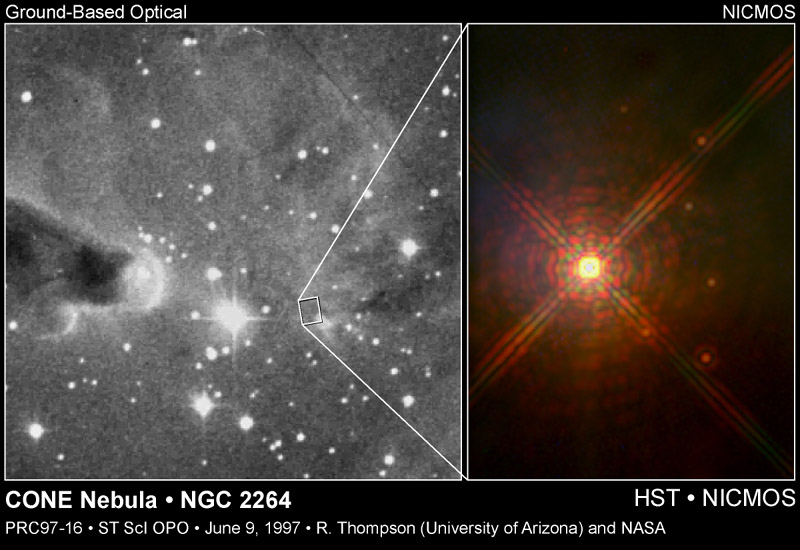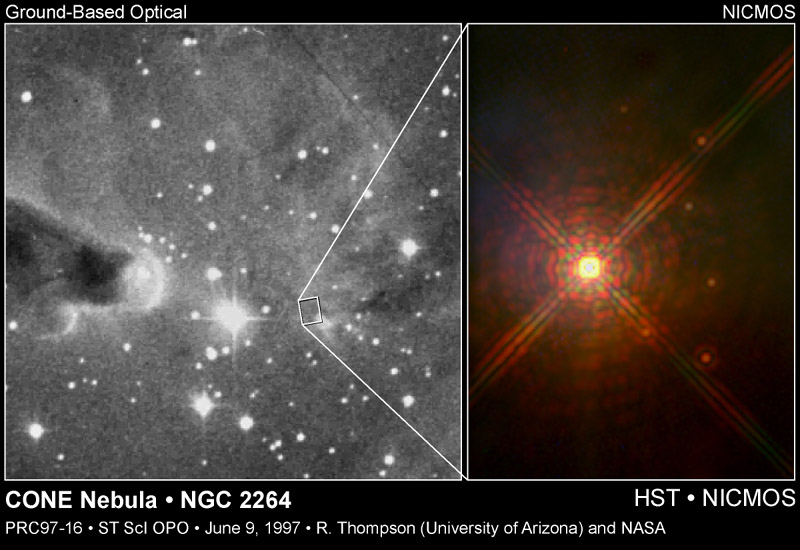
The star cataloged as NGC2264 IRS is normally hidden from the inquiring gaze of optical telescopes. It resides in the midst of the obscuring gas and dust of a nearby star forming region popularly known as the Cone Nebula. Imaged in penetrating infrared light by the Hubble Space Telescope's newly operational NICMOS instrument, this young and massive star was found to be surrounded by six "baby" sun-like stars - all within less than a tenth of a light-year of their "big brother". The diffraction spikes and rings surrounding big brother are image artifacts. Astronomers believe that the high speed winds generated by the massive star compressed nearby material causing the formation of the smaller stars in a text book example of triggered star formation. The newly created suns appear to lie along an otherwise invisible boundary where the high speed gas has collided with the wall of a denser molecular cloud. NGC2264 IRS also seems to be the source of the outflow which created the striking cone shape of the optical nebula.
La estrella catalogada como NGC2264 IRS normalmente permanece oculta a la curiosa mirada de los telescopios ópticos. Se encuentra en el interior del gas y polvo oscurecedor de una región de formación estelar cercana, conocida popularmente como la Nebulosa del Cono. Al ser observada en luz infrarroja penetrante por el recién operativo instrumento NICMOS del Telescopio Espacial Hubble, se descubrió que esta estrella joven y masiva está rodeada por seis estrellas «bebé» similares al Sol, todas ellas a menos de una décima de año luz de su «hermano mayor». Los picos de difracción y los anillos que rodean al hermano mayor son artefactos de la imagen. Los astrónomos creen que los vientos de alta velocidad generados por la estrella masiva comprimieron el material cercano, provocando la formación de las estrellas más pequeñas en un ejemplo de manual de formación estelar desencadenada. Los soles recién creados parecen alinearse a lo largo de una frontera de otro modo invisible, donde el gas de alta velocidad ha colisionado con la pared de una nube molecular más densa. NGC2264 IRS también parece ser la fuente del flujo de salida que dio lugar a la llamativa forma cónica de la nebulosa óptica.