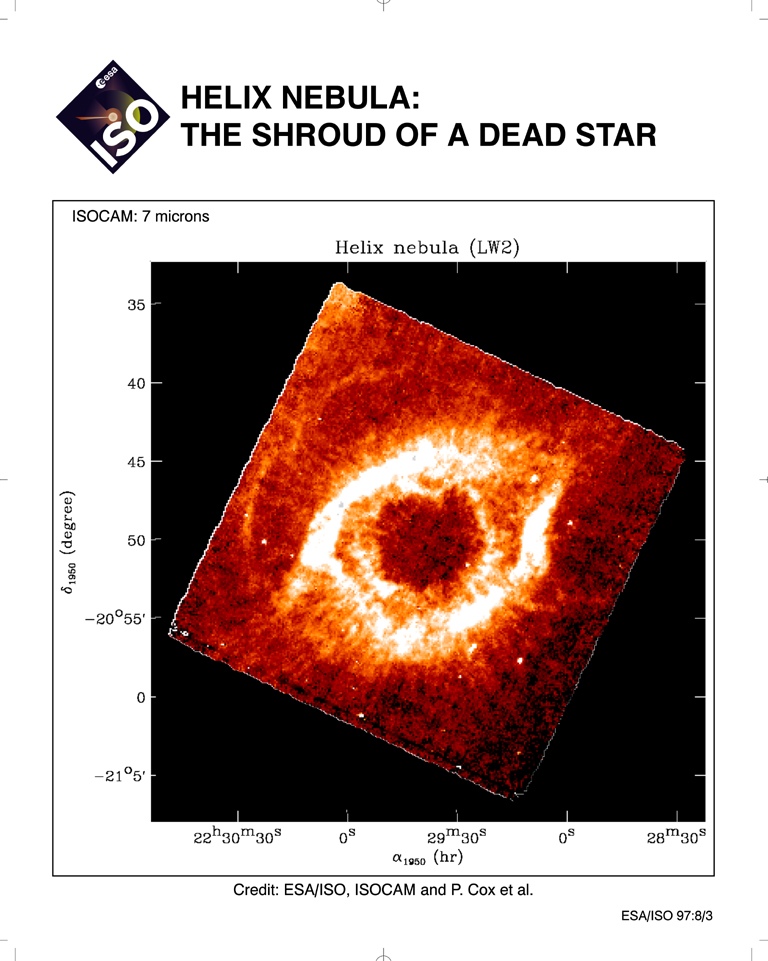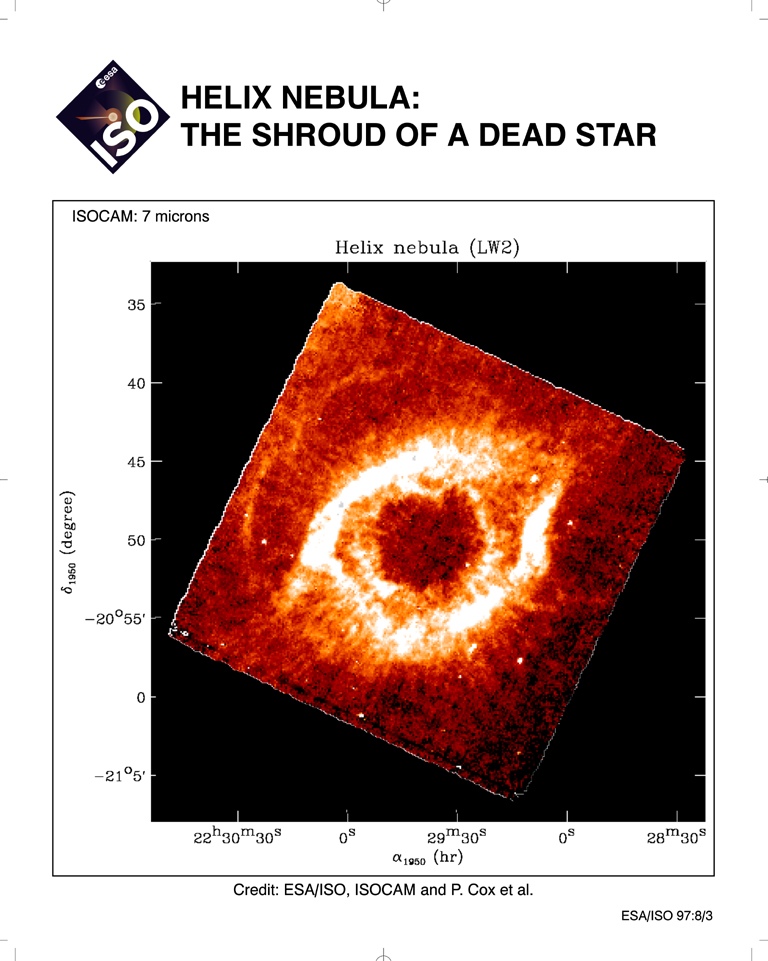
Five hundred light years from Earth, in the constellation Aquarius, a sun-like star is dying. Its last few thousand years have produced the Helix, a well studied and nearby example of a Planetary Nebula - typical of this final phase of stellar evolution. The emission in this Infrared Space Observatory image of the Helix nebula comes mostly from the expanding shells of molecular hydrogen gas. Dust, normally expected in such nebulae, should also radiate strongly at infrared wavelengths but mysteriously seems to be absent here. The culprit may may well be the Helix's central star, a contracting white dwarf. This small but extremely hot star radiates most of its energy at short Ultraviolet wavelengths and is invisible in this infrared mage. Astronomers suspect that over time, this intense Ultraviolet radiation may have destroyed the dust. The Sun is expected to go through its own Planetary Nebula phase ... in another 5 billion years.
A quinientos años luz de la Tierra, en la constelación de Acuario, una estrella similar al Sol está muriendo. Sus últimos miles de años han dado lugar a la Hélice, un ejemplo cercano y ampliamente estudiado de nebulosa planetaria, típica de esta fase final de la evolución estelar. La emisión en esta imagen del Observatorio Espacial Infrarrojo de la nebulosa Hélice proviene principalmente de las capas expansivas de gas hidrógeno molecular. El polvo, que normalmente se espera encontrar en tales nebulosas, debería radiar intensamente en longitudes de onda infrarrojas, pero misteriosamente parece estar ausente aquí. El responsable podría ser perfectamente la estrella central de la Hélice, una enana blanca en contracción. Esta pequeña pero extremadamente caliente estrella irradia la mayor parte de su energía en cortas longitudes de onda ultravioleta y es invisible en esta imagen infrarroja. Los astrónomos sospechan que, con el tiempo, esta intensa radiación ultravioleta puede haber destruido el polvo. Se espera que el Sol atraviese su propia fase de nebulosa planetaria... dentro de otros 5 mil millones de años.