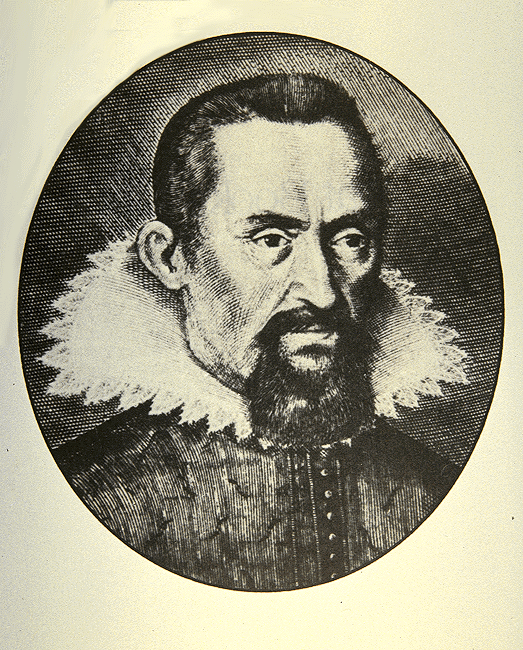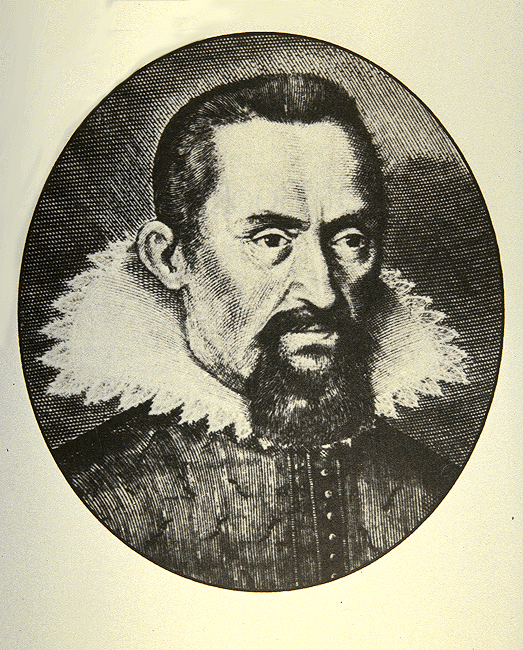
Johannes Kepler used simple mathematics to describe how planets move. Kepler was an assistant to the most accurate astronomical observer of the time, Tycho Brahe. Kepler was able to use Brahe's data to show that planets move in ellipses around the Sun (Kepler's First Law), that planets move proportionally faster in their orbits when they are nearer the Sun (Kepler's Second Law), and that more distant planets take proportionally longer to orbit the Sun (Kepler's Third Law). Kepler lived from 1571 to 1630, during the time of discovery of the telescope. Kepler was one of the few vocal supporters of Galileo's discoveries and the Copernican system of planets orbiting the Sun instead of the Earth.
Johannes Kepler utilizó matemáticas simples para describir el movimiento de los planetas. Kepler fue asistente del observador astronómico más preciso de su época, Tycho Brahe. Kepler logró utilizar los datos de Brahe para demostrar que los planetas se mueven en elipses alrededor del Sol (Primera Ley de Kepler), que los planetas se mueven proporcionalmente más rápido en sus órbitas cuando están más cerca del Sol (Segunda Ley de Kepler), y que los planetas más distantes tardan proporcionalmente más tiempo en orbitar el Sol (Tercera Ley de Kepler). Kepler vivió de 1571 a 1630, durante la época del descubrimiento del telescopio. Kepler fue uno de los pocos defensores entusiastas de los descubrimientos de Galileo y del sistema copernicano de planetas que orbitan alrededor del Sol en lugar de la Tierra.