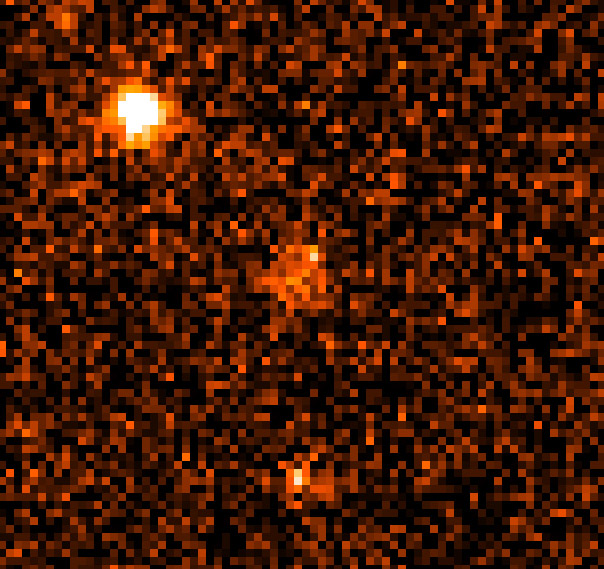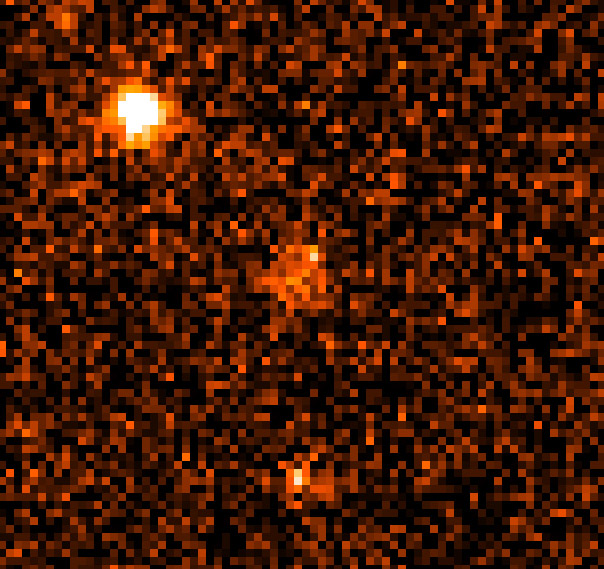
It's still there. The optical counterpart to the instantly famous gamma-ray burst (GRB) that occurred last February 28th has faded - but not completely. The astronomical community had waited patiently for months for the Earth to proceed far enough along in its orbit so that the Sun's glare no longer ruined inspection of the location of this historic flash. The above picture of GRB 970228, taken September 5th and released just yesterday, shows an extended structure in the center that hasn't changed. However, the arrow indicates a point on the upper right that is now five times dimmer than in preceding months. This fading point fits a model where the GRB originated in a fireball across the universe. The constant brightness of the extended feature indicates that it is not reflected emission from the GRB and might be the host galaxy. Even so, the great GRB mystery is not yet over: for one thing, how come other GRBs don't appear to occur in galactic hosts?
Todavía está ahí. La contraparte óptica del célebre destello de rayos gamma (GRB, por sus siglas en inglés) ocurrido el pasado 28 de febrero se ha atenuado, pero no completamente. La comunidad astronómica había esperado pacientemente durante meses a que la Tierra avanzara lo suficiente en su órbita para que el resplandor del Sol dejara de impedir la observación del lugar donde se produjo este histórico destello. La imagen anterior de GRB 970228, tomada el 5 de septiembre y publicada apenas ayer, muestra una estructura extendida en el centro que no ha cambiado. Sin embargo, la flecha señala un punto en la parte superior derecha que ahora es cinco veces más tenue que en los meses anteriores. Este punto en desvanecimiento encaja con un modelo en el que la GRB se originó en una bola de fuego al otro lado del universo. El brillo constante de la estructura extendida indica que no se trata de emisión reflejada por la GRB y podría corresponder a la galaxia anfitriona. Aun así, el gran misterio de las GRB no está resuelto: entre otras cuestiones, ¿por qué otras GRBs no parecen ocurrir en galaxias anfitrionas?