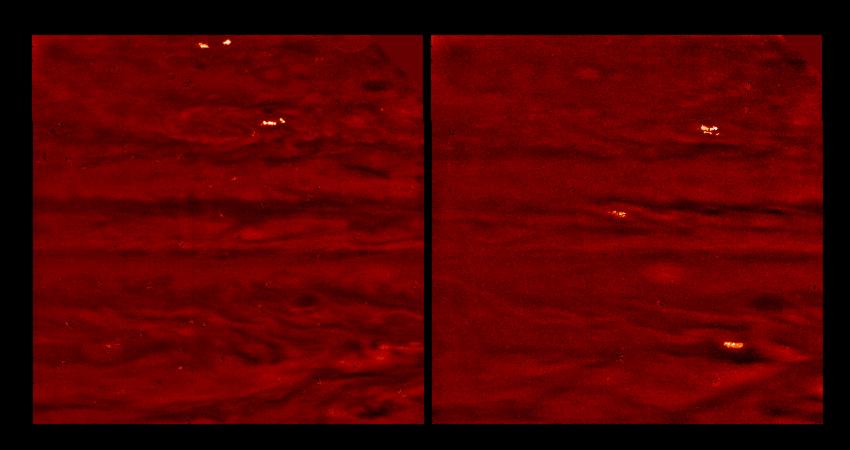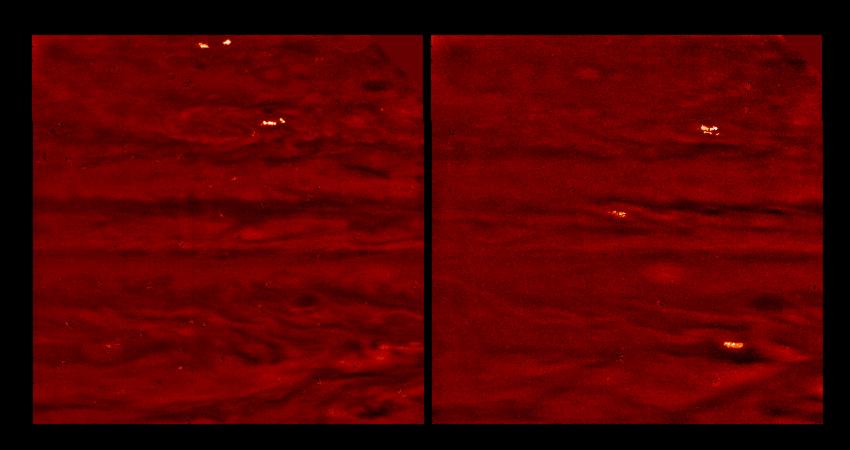
Why is there lightning on Jupiter? Lightning is a sudden rush of electrically charged particles from one location to another. To create lightning, charges must first separate inside a cloud. On Earth, drafts of colliding ice and water droplets usually create this charge separation, but what happens on Jupiter? Many astronomers theorize that Jovian lightning is also created in clouds containing water ice. To help investigate this, the above photograph was taken in October by the Galileo spacecraft now orbiting Jupiter. Clouds are dimly lit by sunlight reflected off Jupiter's moon Io. The bright flashes appear to originate in active regions at the level where water clouds would exist, and illuminate an even lower cloud level containing ammonia. One thing is for sure: lightning on Jupiter is a lot brighter than lighting on Earth.
¿Por qué hay rayos en Júpiter? Un rayo es un repentino desplazamiento de partículas eléctricamente cargadas de un lugar a otro. Para que se produzca un rayo, las cargas deben separarse primero en el interior de una nube. En la Tierra, las corrientes de ascenso que provocan colisiones entre partículas de hielo y gotas de agua suelen generar esta separación de cargas, pero ¿qué ocurre en Júpiter? Muchos astrónomos teorizan que los rayos jovianos también se originan en nubes que contienen hielo de agua. Para investigar este fenómeno, la fotografía anterior fue tomada en octubre por la sonda Galileo, que actualmente orbita Júpiter. Las nubes están tenuemente iluminadas por la luz solar reflejada por Io, una de las lunas de Júpiter. Los brillantes destellos parecen originarse en regiones activas situadas al nivel donde existirían nubes de agua, e iluminan un estrato de nubes aún más bajo que contiene amoníaco. Algo es seguro: los rayos en Júpiter son mucho más brillantes que los rayos en la Tierra.