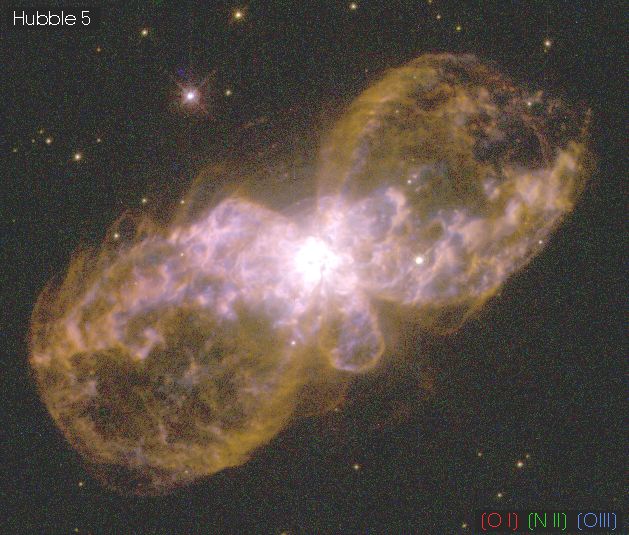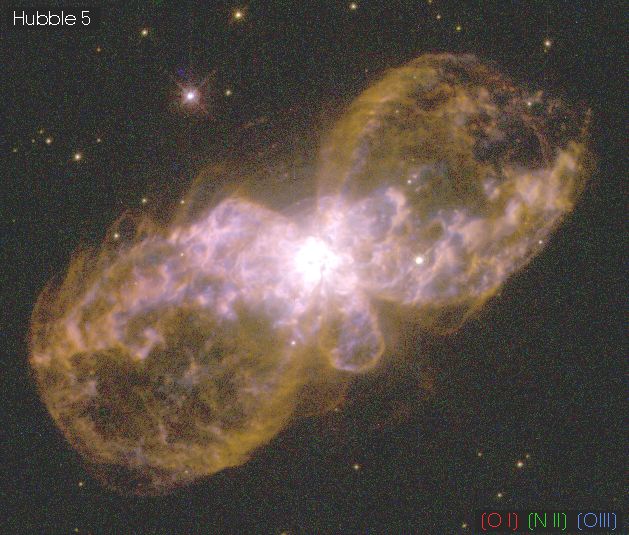
The Hubble Double Bubble Planetary Nebula is bubbling over with excitement. More mundanely known as Hubble 5, this bipolar planetary nebula is being created by a hot wind of particles streaming away from the central star system. The hot gas expands into the surrounding interstellar medium in a fashion similar to the inflation of hot air balloons. A supersonic shock-wave can form at the boundary, causing newly excited gas there to shine as electrons recombine with resident elements. In the above picture, colors are assigned according to the energy of the recombinant radiation. This star system lies about 2200 light-years from Earth, and likely includes a Sun-like star slowly transforming itself into a white dwarf.
La Nebulosa Planetaria de la Doble Burbuja de Hubble rebosa de actividad. Conocida más formalmente como Hubble 5, esta nebulosa planetaria bipolar está siendo creada por un viento caliente de partículas que se alejan del sistema estelar central. El gas caliente se expande hacia el medio interestelar circundante de manera similar a la inflación de globos de aire caliente. Una onda de choque supersónica puede formarse en el límite, provocando que el gas recién excitado brille al recombinarse los electrones con los elementos presentes. En la imagen superior, los colores se asignan según la energía de la radiación de recombinación. Este sistema estelar se encuentra a unos 2.200 años-luz de la Tierra, y probablemente incluye una estrella similar al Sol que se está transformando lentamente en una enana blanca.