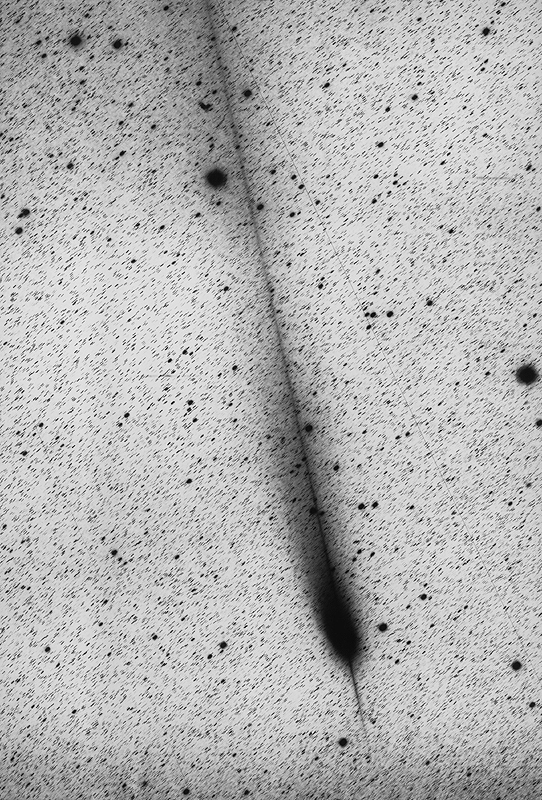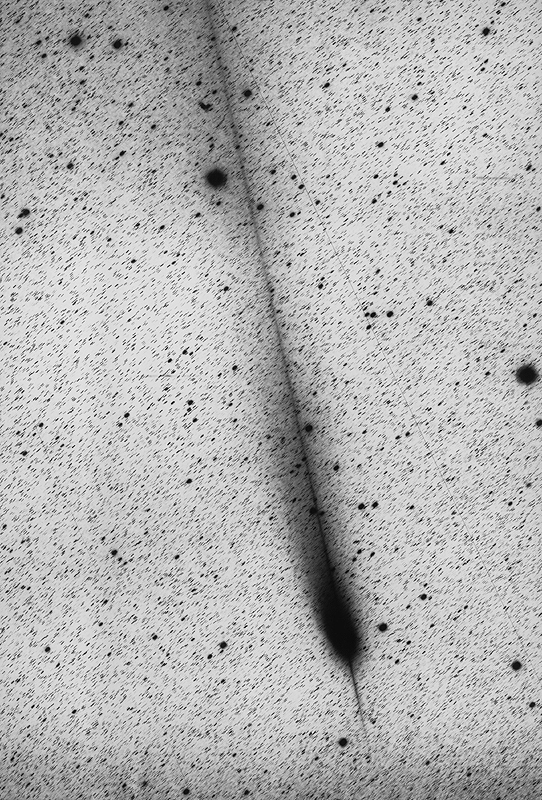
Where is Hale-Bopp now? The Great Comet of 1997, one of the largest and most active comets ever, is outbound about 400 million miles from the sun. Too faint for viewing without telescopes or binoculars, Hale-Bopp is presently positioned in the very southerly constellation of Pictor. This "negative" image (black stars against white sky) of Hale-Bopp is the result of a 1 hour time exposure using the 1-metre European Southern Observatory Schmidt telescope on January 5. Clearly the comet still has a substantial tail, blown by the solar wind, that points generally away from the sunward direction. But look closely. A spiky "anti-tail" is also visible pointing toward the sun! It is likely that this anti-tail is composed of dust grains released from the comet nucleus which are too large to be easily pushed by the solar wind. As Hale-Bopp recedes from the sun its activity will subside but astronomers are still uncertain as to how long its tails will last. After a swing through the outer solar system and the Oort cloud, Hale-Bopp will pass through the inner solar system again ... around the year 5400.
¿Dónde se encuentra Hale-Bopp ahora? El Gran Cometa de 1997, uno de los más grandes y activos jamás observados, se aleja del Sol a una distancia de aproximadamente 640 millones de kilómetros. Demasiado tenue para ser observado a simple vista o con prismáticos, Hale-Bopp se encuentra actualmente en la constelación austral de Pictor. Esta imagen "negativa" (estrellas negras sobre fondo blanco) de Hale-Bopp es el resultado de una exposición de 1 hora realizada con el telescopio Schmidt de 1 metro del Observatorio Europeo Austral el 5 de enero. Claramente, el cometa aún posee una cola sustancial, impulsada por el viento solar, que apunta en dirección general opuesta al Sol. Pero obsérvese con atención: también es visible una "anti-cola" puntiaguda que apunta hacia el Sol. Es probable que esta anti-cola esté compuesta por granos de polvo liberados del núcleo del cometa, demasiado grandes para ser desplazados fácilmente por el viento solar. A medida que Hale-Bopp se aleja del Sol, su actividad irá disminuyendo, aunque los astrónomos aún no tienen certeza sobre cuánto tiempo durarán sus colas. Tras un recorrido por el sistema solar exterior y la nube de Oort, Hale-Bopp volverá a transitar por el sistema solar interior... alrededor del año 5400.