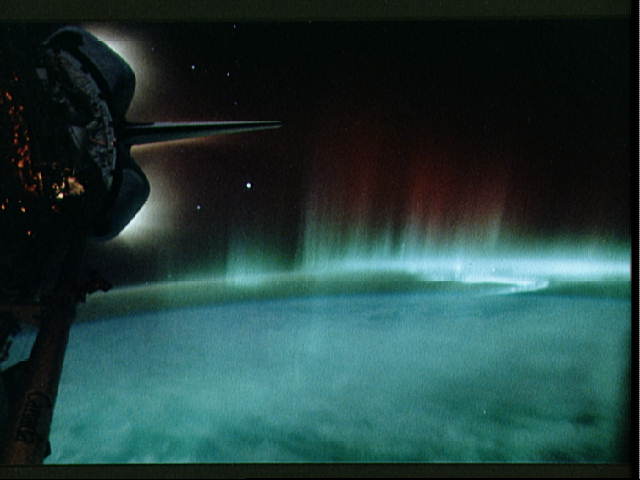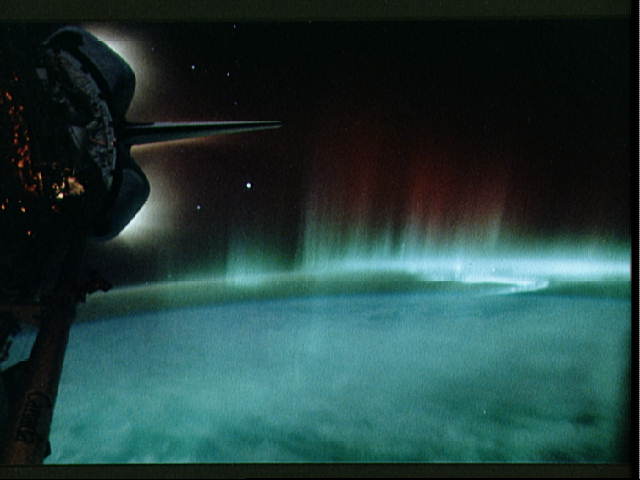
A background of distant stars, sinuous and spiky bands of Southern Lights (Aurora Australis), and the faint glow of charged plasma (ionized atomic gas) surrounding the Space Shuttle Discovery's engines give this photo from the STS-39 mission an eerie, otherworldly look. This image reflects Discovery's April 1991 mission well - its payload bay (PLB) was filled with instruments designed to study celestial objects, aurora and atmospheric phenomena, and the low Earth orbit environment around the PLB itself. The aurora seen here are at a height of about 50-80 miles. Aurora are caused by charged particles in the solar wind, channeled through the Earth's magnetic field which excite molecules in the upper atmosphere.
Un fondo de estrellas distantes, sinuosas y puntiagudas bandas de Luces Australes (Aurora Australis), y el tenue resplandor del plasma cargado (gas atómico ionizado) que rodea los motores del Transbordador Espacial Discovery confieren a esta fotografía de la misión STS-39 un aspecto inquietante y de otro mundo. Esta imagen refleja fielmente la misión de Discovery de abril de 1991: su bahía de carga útil (PLB, por sus siglas en inglés) estaba repleta de instrumentos diseñados para estudiar objetos celestes, auroras y fenómenos atmosféricos, así como el entorno de órbita terrestre baja alrededor de la propia PLB. Las auroras visibles en esta imagen se encuentran a una altura de aproximadamente 80 a 130 kilómetros. Las auroras son causadas por partículas cargadas del viento solar, canalizadas a través del campo magnético terrestre, que excitan las moléculas en la atmósfera superior.