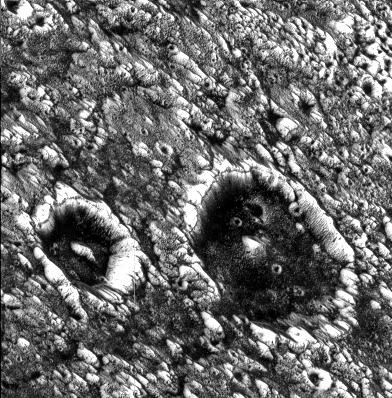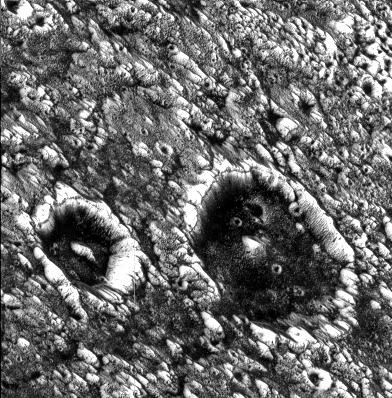
Ganymede has craters within craters within craters. The old surface of the largest moon in the Solar System shows its age by the large amount of these impact features. The above picture released last week shows two old craters with dark floors located in a relatively bright region known as Memphis Facula, a region itself thought created by an ancient collision. The strange dark floors of these craters were themselves created long ago and now house craters of their own. Crater Chrysor, on the left, spans about 6000 meters, about half that of crater Aleyn on the right. The robot spacecraft Galileo took the above photograph during a flyby of this moon of Jupiter in June 1996.
Ganímedes tiene cráteres dentro de cráteres dentro de cráteres. La antigua superficie de la luna más grande del Sistema Solar muestra su edad por la gran cantidad de estos accidentes de impacto. La imagen publicada la semana pasada muestra dos antiguos cráteres con fondos oscuros ubicados en una región relativamente brillante conocida como Memphis Facula, una región que se cree fue creada por una antigua colisión. Los extraños fondos oscuros de estos cráteres también se formaron hace mucho tiempo y albergan ahora sus propios cráteres. El cráter Chrysor, a la izquierda, abarca unos 6000 metros, aproximadamente la mitad que el cráter Aleyn, a la derecha. La nave espacial robótica Galileo tomó esta fotografía durante un sobrevuelo de esta luna de Júpiter en junio de 1996.