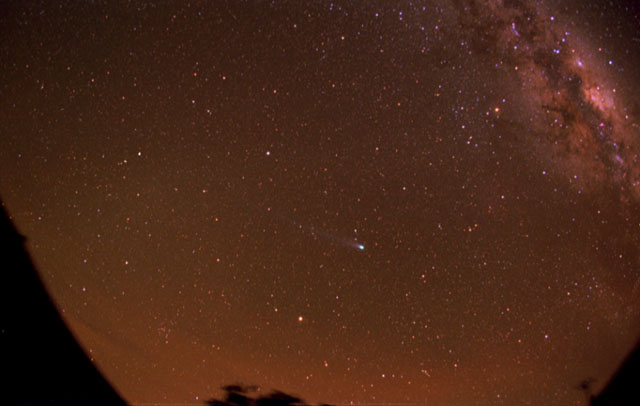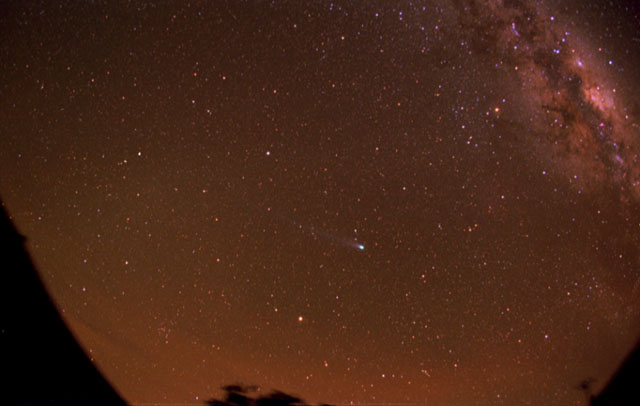
Two years ago, the Great Comet of 1996, Comet Hyakutake, inched across our northern sky during its long orbit around the Sun. Visible above as the bright spot with the faint tail near the picture's center, Comet Hyakutake shares the stage with part of the central band of the Milky Way Galaxy, prominent in the picture's upper right. Also visible are Antares, the bright orange star in the upper right, Arcturus, the bright star on the lower left, and the Pipe Nebula, which is perhaps harder to find. Comet Hyakutake's unusually close approach to the Earth allowed astronomers to learn many things, including that comets can emit much X-ray light.
Hace dos años, el Gran Cometa de 1996, el Cometa Hyakutake, se desplazaba lentamente por nuestro cielo boreal durante su larga órbita alrededor del Sol. Visible en la imagen como el punto brillante con una tenue cola cerca del centro, el Cometa Hyakutake comparte protagonismo con parte de la banda central de la Galaxia Vía Láctea, destacada en la esquina superior derecha de la imagen. También son visibles Antares, la brillante estrella anaranjada en la parte superior derecha, Arcturus, la estrella brillante en la parte inferior izquierda, y la Nebulosa de la Pipa, quizás más difícil de localizar. La aproximación inusualmente cercana del Cometa Hyakutake a la Tierra permitió a los astrónomos aprender muchas cosas, entre ellas que los cometas pueden emitir una gran cantidad de luz en rayos X.