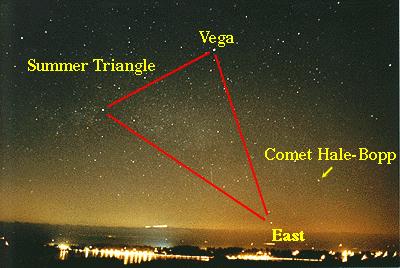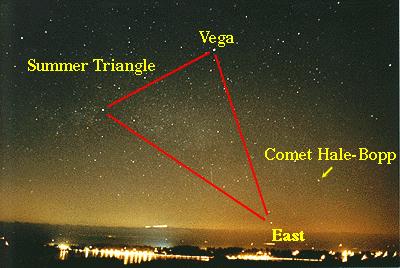
Vega is a bright blue star 25 light years away. Vega is the brightest star in the Summer Triangle, a group of stars easily visible summer evenings in the northern hemisphere. The name Vega derives from Arabic origins, and means "stone eagle." 4,000 years ago, however, Vega was known by some as "Ma'at" - one example of ancient human astronomical knowledge and language. 14,000 years ago, Vega, not Polaris, was the north star. Vega is the fifth brightest star in the night sky, and has a diameter almost three times that of our Sun. Life bearing planets, rich in liquid water, could possibly exist around Vega. The above picture, taken in January 1997, finds Vega, the Summer Triangle, and Comet Hale-Bopp high above Victoria, British Columbia, Canada.
Vega es una brillante estrella azul situada a 25 años luz de distancia. Es la estrella más brillante del Triángulo de Verano, un grupo de estrellas fácilmente visible en las noches de verano en el hemisferio norte. El nombre Vega tiene origen árabe y significa "águila de piedra". Hace 4.000 años, sin embargo, Vega era conocida por algunos como "Ma'at", un ejemplo del conocimiento astronómico y lingüístico de las antiguas civilizaciones humanas. Hace 14.000 años, Vega, y no Polaris, era la estrella polar norte. Vega es la quinta estrella más brillante del cielo nocturno y tiene un diámetro casi tres veces mayor que el de nuestro Sol. Es posible que alrededor de Vega existan planetas con condiciones para albergar vida, ricos en agua líquida. La imagen anterior, tomada en enero de 1997, muestra a Vega, el Triángulo de Verano y el cometa Hale-Bopp en lo alto del cielo sobre Victoria, Columbia Británica, Canadá.