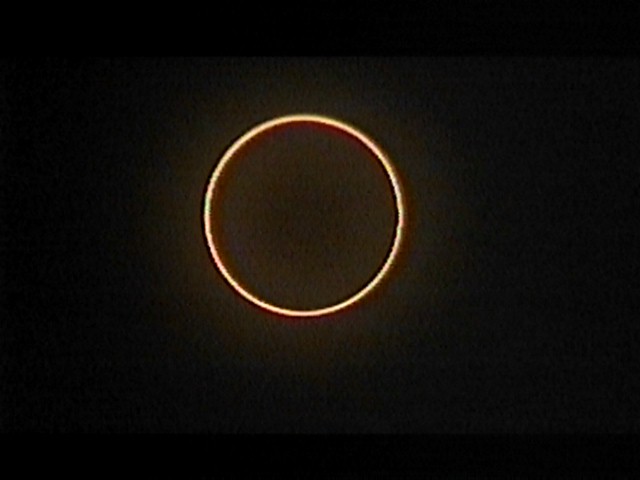
An annular eclipse of the Sun was visible in parts of the Eastern Hemisphere on Saturday. The above picture was taken at that time by a video camera in Mersing on the East Coast of Malaysia and emailed to APOD yesterday from an internet cafe in Kuala Lumpur. An annular solar eclipse will occur when the Moon's angular size is slightly less than the Sun's angular size. Therefore, when the Moon is directly in front of the Sun, the edges of the Sun are still visible. This solar ring is so bright that the Moon's surface normally appears dark by comparison. The angular sizes of the Sun and Moon change slightly because of the elliptical nature of the Moon's and Earth's orbit. A total solar eclipse would have occurred were the Moon much closer to the Earth.
Un eclipse anular de Sol fue visible en partes del Hemisferio Oriental el sábado pasado. La imagen superior fue tomada en ese momento por una cámara de video en Mersing, en la costa este de Malasia, y enviada por correo electrónico a APOD desde un café de internet en Kuala Lumpur. Un eclipse solar anular ocurre cuando el tamaño angular de la Luna es ligeramente menor que el tamaño angular del Sol. Por lo tanto, cuando la Luna se encuentra directamente frente al Sol, los bordes de este último siguen siendo visibles. Este anillo solar es tan brillante que la superficie de la Luna normalmente aparece oscura en comparación. Los tamaños angulares del Sol y la Luna varían ligeramente debido a la naturaleza elíptica de las órbitas de la Luna y la Tierra. Un eclipse solar total habría ocurrido si la Luna estuviera mucho más cerca de la Tierra.