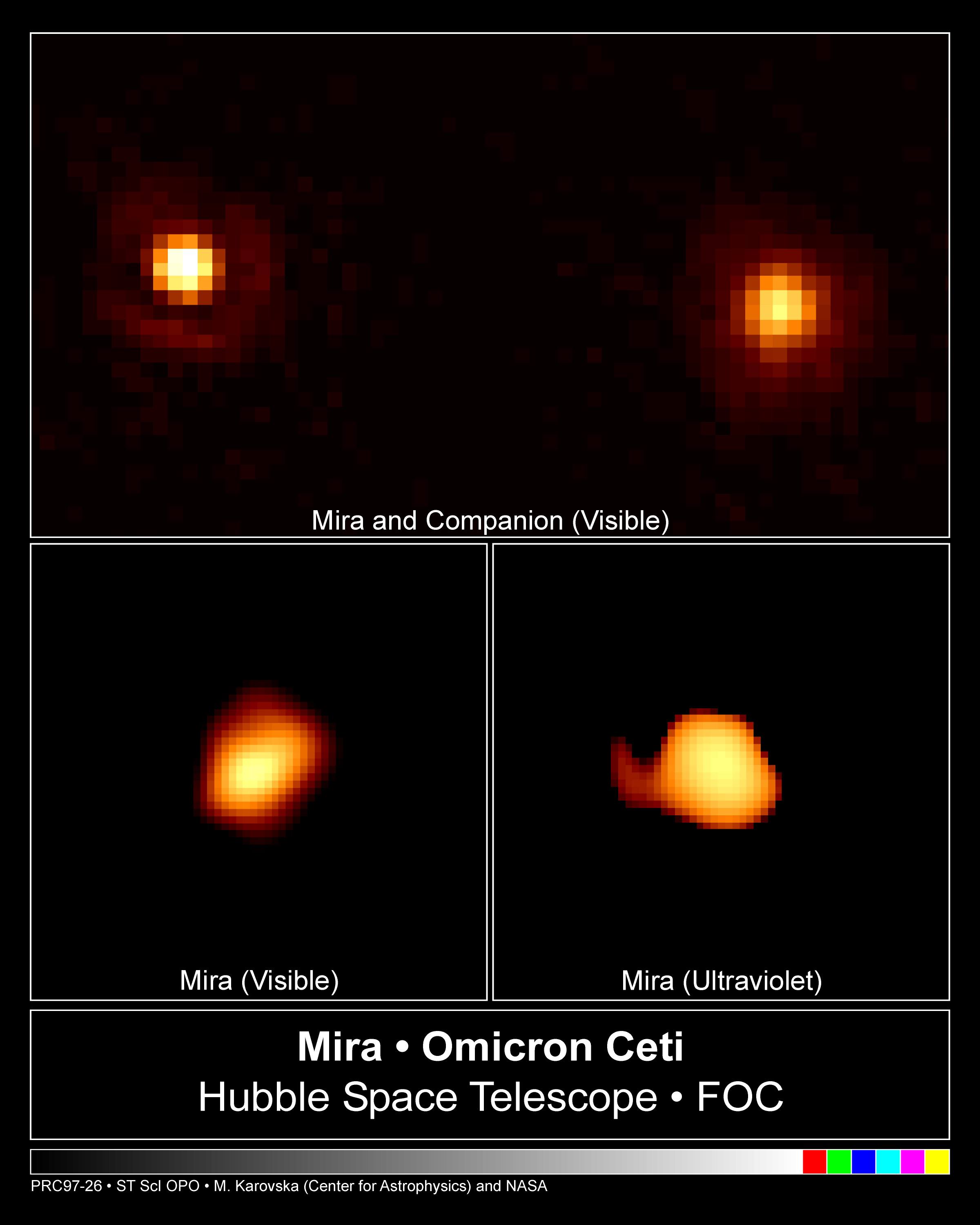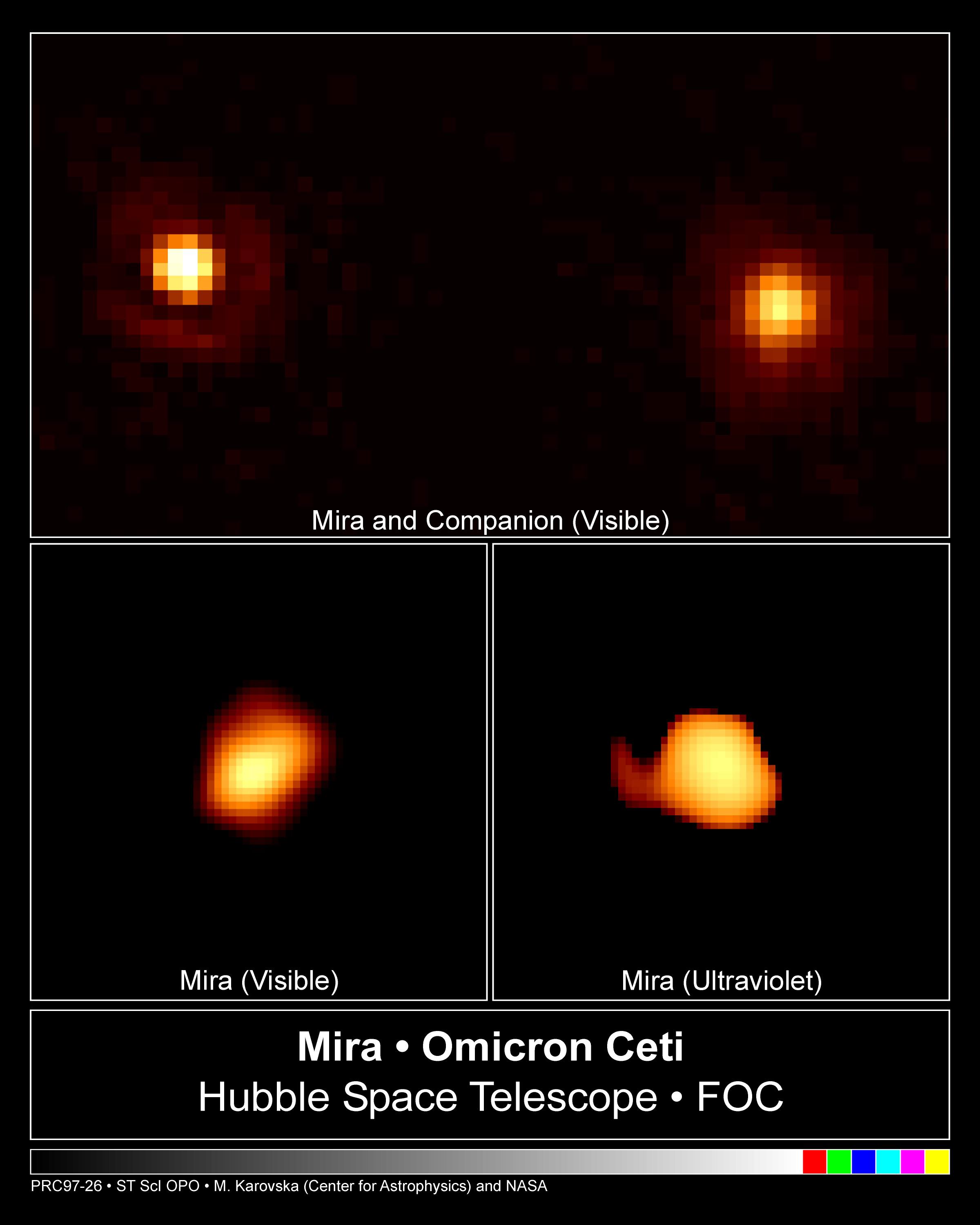
Most stars appear only as points of light. Early last year, Betelgeuse became the second star, after our Sun, to have it surface resolved. Later last year, Mira was added to the list. Mira A is a red giant star undergoing dramatic pulsations, causing it to become more than 100 times brighter over the course of a year. Mira was discovered to be the first variable star 401 years ago today by David Fabricus. Mira can extend to over 700 times the size of our Sun, and is only 400 light-years away. The above photograph taken by the Hubble Space Telescope shows the true face of Mira. But what are we seeing? The unusual extended feature off the lower left of the star remains somewhat mysterious. Possible explanations include gravitational perturbation and/or heating from Mira's white dwarf star companion
La mayoría de las estrellas aparecen únicamente como puntos de luz. A principios del año pasado, Betelgeuse se convirtió en la segunda estrella, después de nuestro Sol, en tener su superficie resuelta. Más tarde ese mismo año, Mira se añadió a la lista. Mira A es una estrella gigante roja que experimenta pulsaciones dramáticas, lo que la hace volverse más de 100 veces más brillante en el transcurso de un año. Mira fue descubierta como la primera estrella variable hace 401 años, precisamente hoy, por David Fabricus. Mira puede extenderse hasta más de 700 veces el tamaño de nuestro Sol y se encuentra a tan solo 400 años-luz de distancia. La fotografía anterior, tomada por el Telescopio Espacial Hubble, muestra el verdadero rostro de Mira. Pero, ¿qué estamos viendo? La inusual extensión que se observa hacia la parte inferior izquierda de la estrella sigue siendo en cierta medida misteriosa. Entre las posibles explicaciones se incluyen la perturbación gravitacional y/o el calentamiento provocado por la estrella compañera enana blanca de Mira.