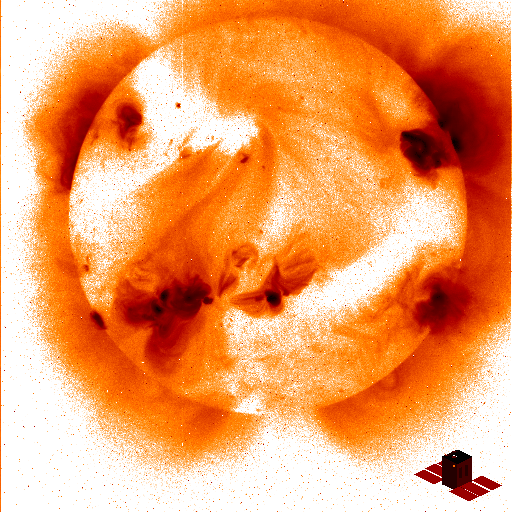
The Earth's orbit is not a perfect, sun-centered circle. At aphelion, the most distant point in Earth's orbit, the Sun is 150 million kilometers away and at perihelion, the closest point, Earth approaches the Sun to within about 147 million kilometers. While aphelion occurs in July, perihelion for planet Earth comes in January. In fact, inhabitants of the Northern Hemisphere, particularly those wearily weathering winter storms, may be surprised to learn that Earth reached its closest point to the Sun on January 3rd this year. This false-color picture recorded near perihelion is from the earth-orbiting Yohkoh Solar Observatory. It shows an increasingly active Sun in the light of X-rays. A negative color scheme is used, darker colors representing more intense X-ray light.
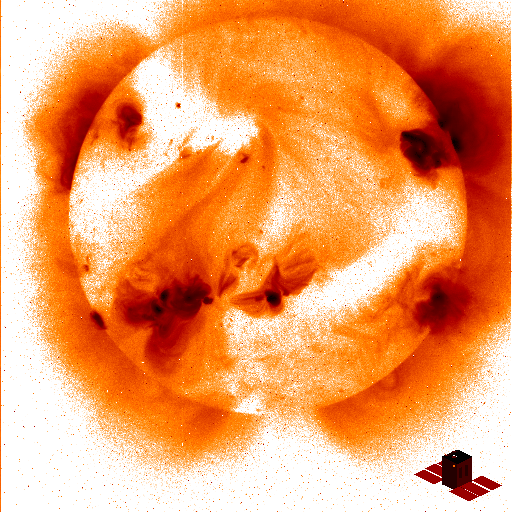
La órbita de la Tierra no es un círculo perfecto centrado en el Sol. En el afelio, el punto más distante de la órbita terrestre, el Sol se encuentra a 150 millones de kilómetros de distancia; en el perihelio, el punto más cercano, la Tierra se aproxima al Sol hasta unos 147 millones de kilómetros. Mientras que el afelio ocurre en julio, el perihelio para el planeta Tierra tiene lugar en enero. De hecho, los habitantes del hemisferio norte, especialmente aquellos que soportan con fatiga las tormentas invernales, pueden sorprenderse al saber que la Tierra alcanzó su punto más cercano al Sol el pasado 3 de enero. Esta imagen en falso color, registrada cerca del perihelio, proviene del Observatorio Solar Yohkoh en órbita terrestre. Muestra un Sol cada vez más activo a la luz de los rayos X. Se utiliza un esquema de color negativo, en el que los colores más oscuros representan una mayor intensidad de la luz en rayos X.