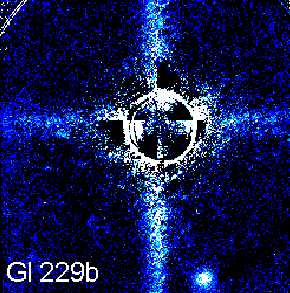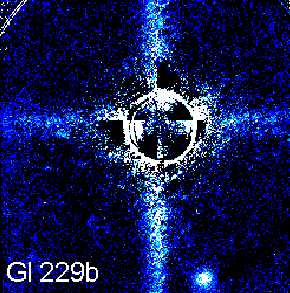
The spot near the bottom is an image of an unusual type of object: a brown dwarf. A brown dwarf is sometimes called a "failed star" because it does not have enough mass to shine by nuclear fusion. A brown dwarf is more massive than a planet, though, and thought to have formed through stellar-like nebular condensation. Brown dwarfs and planets are likely quite abundant, but usually difficult to see in the glare of brighter stars they orbit. New techniques, such as using coronagraphic masks to block the light of the bright star, are allowing the detection of these faint stellar companions. Above, much of the bright light of central Gliese 229A has been blocked and digitally subtracted, leaving the clearest image yet of Gliese 229B. Perfecting techniques like this increases ability to detect still dimmer Earth-type planets orbiting nearby stars.
El punto cerca de la parte inferior es la imagen de un tipo inusual de objeto: una enana marrón. Una enana marrón es denominada a veces una "estrella fallida" porque no posee masa suficiente para brillar mediante fusión nuclear. Sin embargo, una enana marrón es más masiva que un planeta, y se cree que se formó mediante condensación nebular similar a la estelar. Las enanas marrones y los planetas son probablemente muy abundantes, pero generalmente difíciles de detectar debido al resplandor de las estrellas más brillantes que orbitan. Nuevas técnicas, como el uso de máscaras coronagráficas para bloquear la luz de la estrella brillante, están permitiendo la detección de estas tenues compañeras estelares. En la imagen, gran parte de la luz brillante de Gliese 229A central ha sido bloqueada y sustraída digitalmente, dejando la imagen más nítida hasta la fecha de Gliese 229B. El perfeccionamiento de técnicas como esta incrementa la capacidad de detectar planetas de tipo Tierra aún más tenues que orbitan estrellas cercanas.