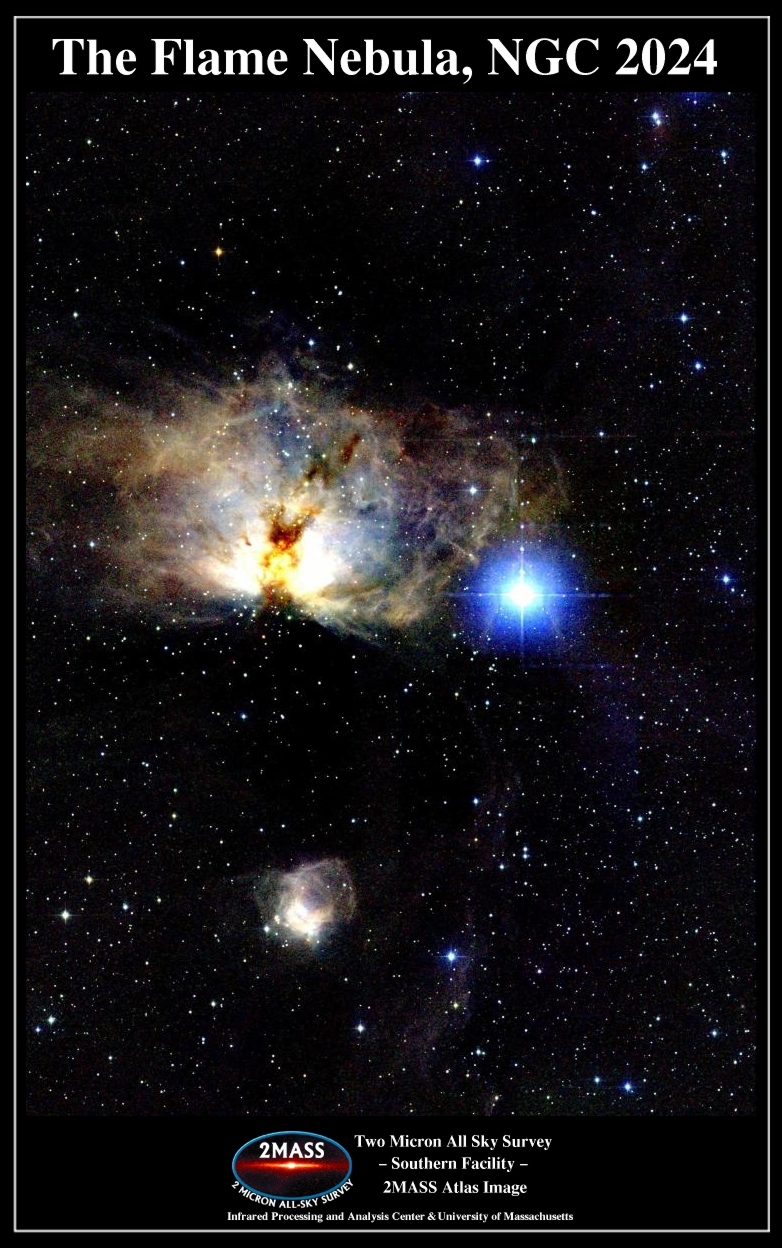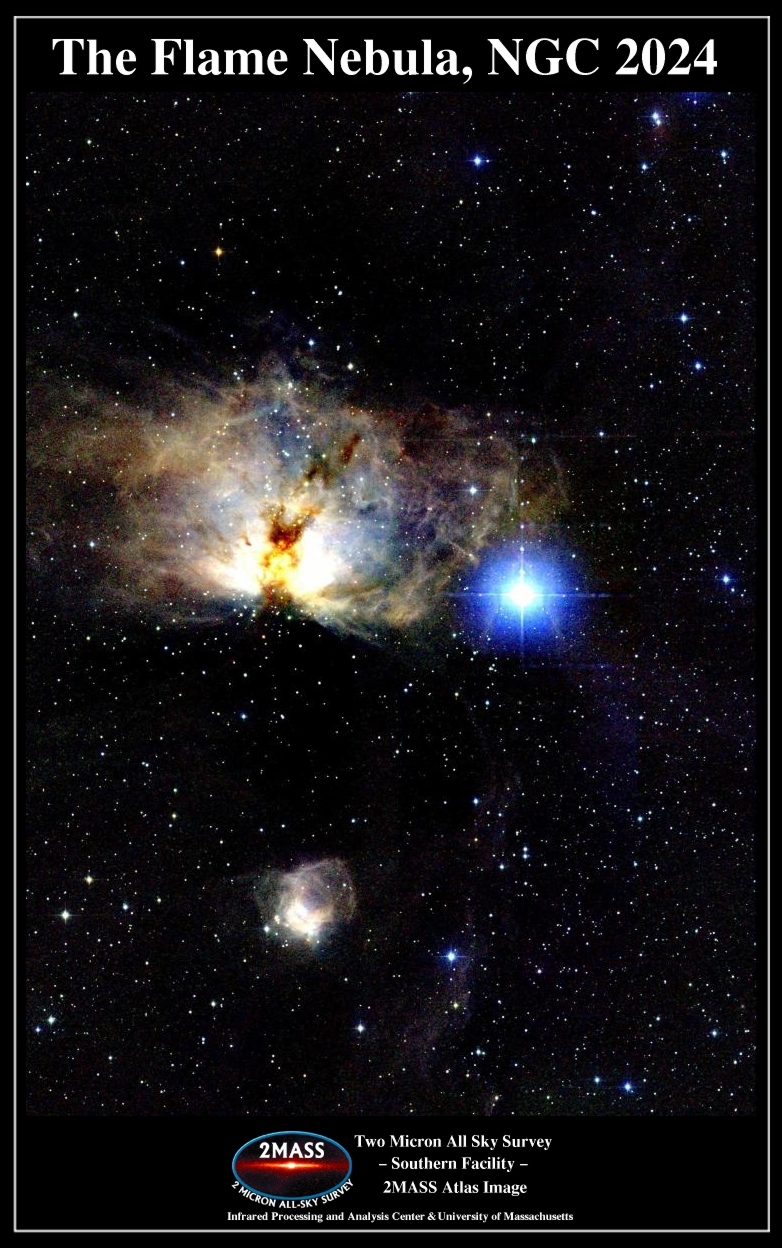
What lights up the Flame Nebula? Fifteen hundred light years away towards the constellation of Orion lies a nebula which, from its glow and dark dust lanes, appears like a billowing fire. But fire, the rapid acquisition of oxygen, is not what makes this Flame glow. Rather the bright star Alnitak, the easternmost star in the Belt of Orion visible to the nebula's right, shines energetic light into the Flame that knocks electrons away from the great clouds of hydrogen gas that reside there. Much of the glow results when the electrons and ionized hydrogen recombine. The above false-color picture of the Flame Nebula (NGC 2024) was taken in infrared light, where a young star cluster becomes visible. The Flame Nebula is part of the Orion Molecular Cloud Complex, a star-forming region that includes the famous Horsehead Nebula.
¿Qué ilumina la Nebulosa de la Llama? A mil quinientos años luz de distancia, en dirección a la constelación de Orión, se encuentra una nebulosa que, por su resplandor y sus oscuras franjas de polvo, parece una llama ondeante. Sin embargo, el fuego, entendido como la rápida captación de oxígeno, no es lo que hace brillar esta Llama. En cambio, la brillante estrella Alnitak, la estrella más oriental del Cinturón de Orión visible a la derecha de la nebulosa, proyecta luz energética sobre la Llama y arranca electrones de las grandes nubes de gas hidrógeno que residen en ella. Gran parte del resplandor se produce cuando los electrones y el hidrógeno ionizado se recombinan. La imagen en falso color de la Nebulosa de la Llama (NGC 2024) que se muestra arriba fue tomada en luz infrarroja, donde se hace visible un joven cúmulo estelar. La Nebulosa de la Llama forma parte del Complejo de Nubes Moleculares de Orión, una región de formación estelar que incluye la famosa Nebulosa Cabeza de Caballo.