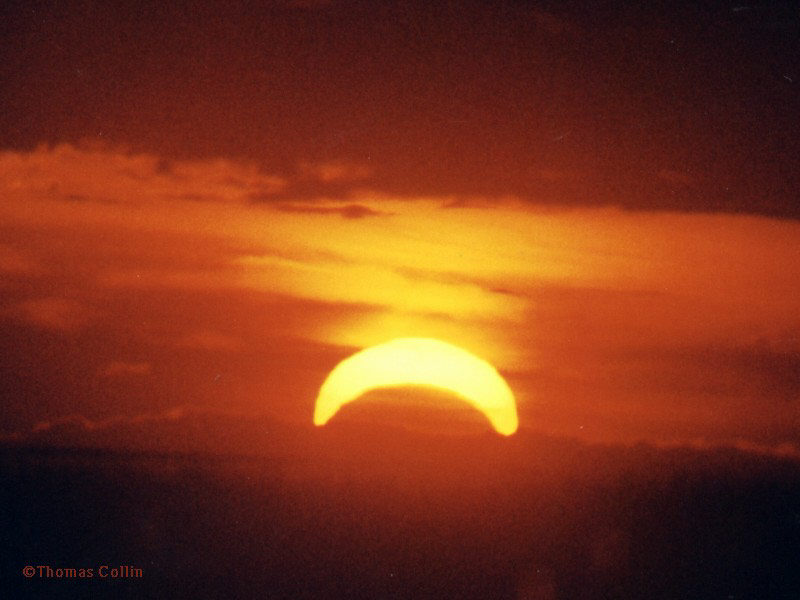
Normally, the Moon shows phases, but the Sun does not. The reason is founded in the fact that the Moon shines only by reflected sunlight. When the Moon is closer to the Sun than the Earth, only part of it appears to be lit - resulting in a familiar crescent-shaped phase. Last Wednesday, however, many viewers in eastern North America were treated to an unusual sunrise where the Sun appeared to itself rise in a crescent phase. Nothing was wrong with Sun - viewers were witnessing the end of a solar eclipse. This unusual sight was caught above during a cloudy morning in Quebec. A similar sunrise eclipse recorded almost 3000 years ago has allowed historians to attempt to match ancient and modern calendars.
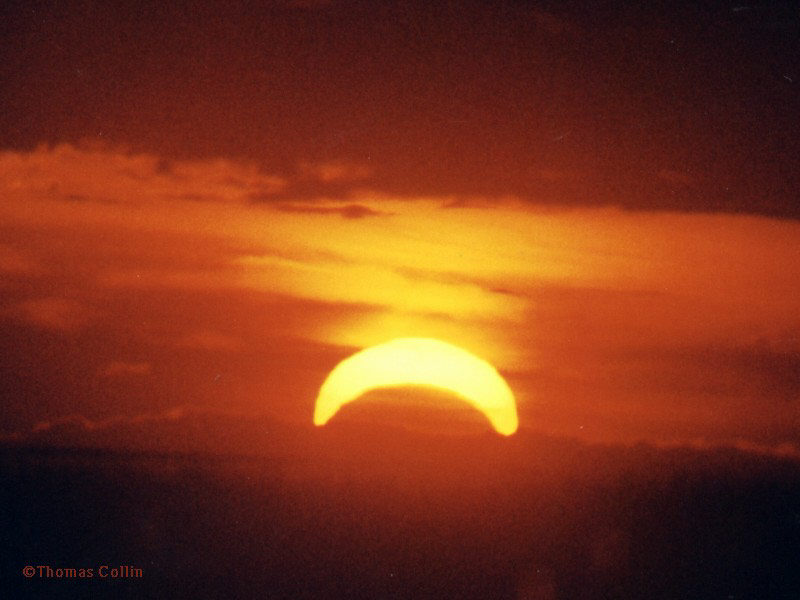
Normalmente, la Luna muestra fases, pero el Sol no. La razón se fundamenta en el hecho de que la Luna brilla únicamente por la luz solar reflejada. Cuando la Luna está más cerca del Sol que la Tierra, solo una parte de ella parece estar iluminada, dando lugar a la familiar fase de creciente. El pasado miércoles, sin embargo, muchos observadores en el este de América del Norte fueron testigos de un inusual amanecer en el que el Sol pareció salir él mismo en fase de creciente. No había nada anómalo en el Sol: los observadores estaban presenciando el final de un eclipse solar. Esta insólita imagen fue capturada durante una mañana nublada en Quebec. Un eclipse similar al amanecer registrado hace casi 3000 años ha permitido a los historiadores intentar correlacionar los calendarios antiguos y modernos.