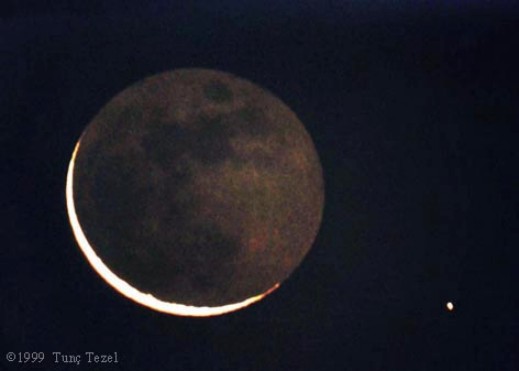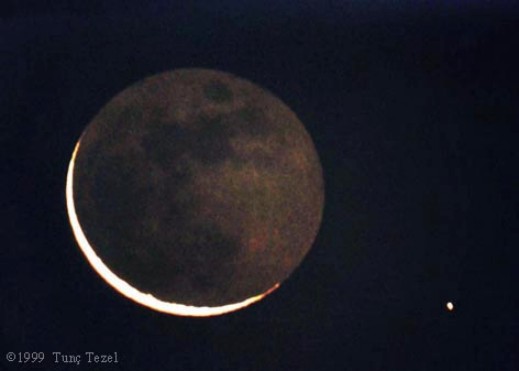
Mercury is the closest planet to the Sun and never moves far from our parent star in Earth's sky. Racing around its tight orbit, this well-done world is a little over 1/3 the diameter of Earth and is often lost to our view in the solar glare. But, just one day before the August 11 total solar eclipse, astronomer Tunc Tezel captured this fleeting view of a close conjunction of Mercury and the soon to be silhouetted Moon as seen from Turkey. Mercury at the lower right shines brightly in reflected sunlight while only a thin crescent of the almost new Moon is directly illuminated. The rest of the lunar nearside is faintly visible though, illuminated by light from an almost full Earth. On Monday, November 15th, Mercury will actually be seen to transit or pass across the disk of the Sun for well placed observers in the pacific hemisphere.
Mercurio es el planeta más cercano al Sol y nunca se aleja demasiado de nuestra estrella en el cielo terrestre. Siguiendo velozmente su ajustada órbita, este mundo bien logrado posee un diámetro apenas superior a 1/3 del de la Tierra y con frecuencia se pierde a nuestra vista en el resplandor solar. Sin embargo, justo un día antes del eclipse solar total del 11 de agosto, el astrónomo Tunc Tezel capturó esta fugaz vista de una estrecha conjunción entre Mercurio y la Luna, próxima a ser silueteada, tal como se observó desde Turquía. Mercurio, en la parte inferior derecha, brilla intensamente con la luz solar reflejada, mientras que solo una delgada crescent de la Luna casi nueva está directamente iluminada. No obstante, el resto de la cara visible de la Luna es tenuemente perceptible, iluminado por la luz proveniente de una Tierra casi llena. El lunes 15 de noviembre, Mercurio podrá ser observado transitando o cruzando el disco solar por aquellos observadores bien situados en el hemisferio del Pacífico.