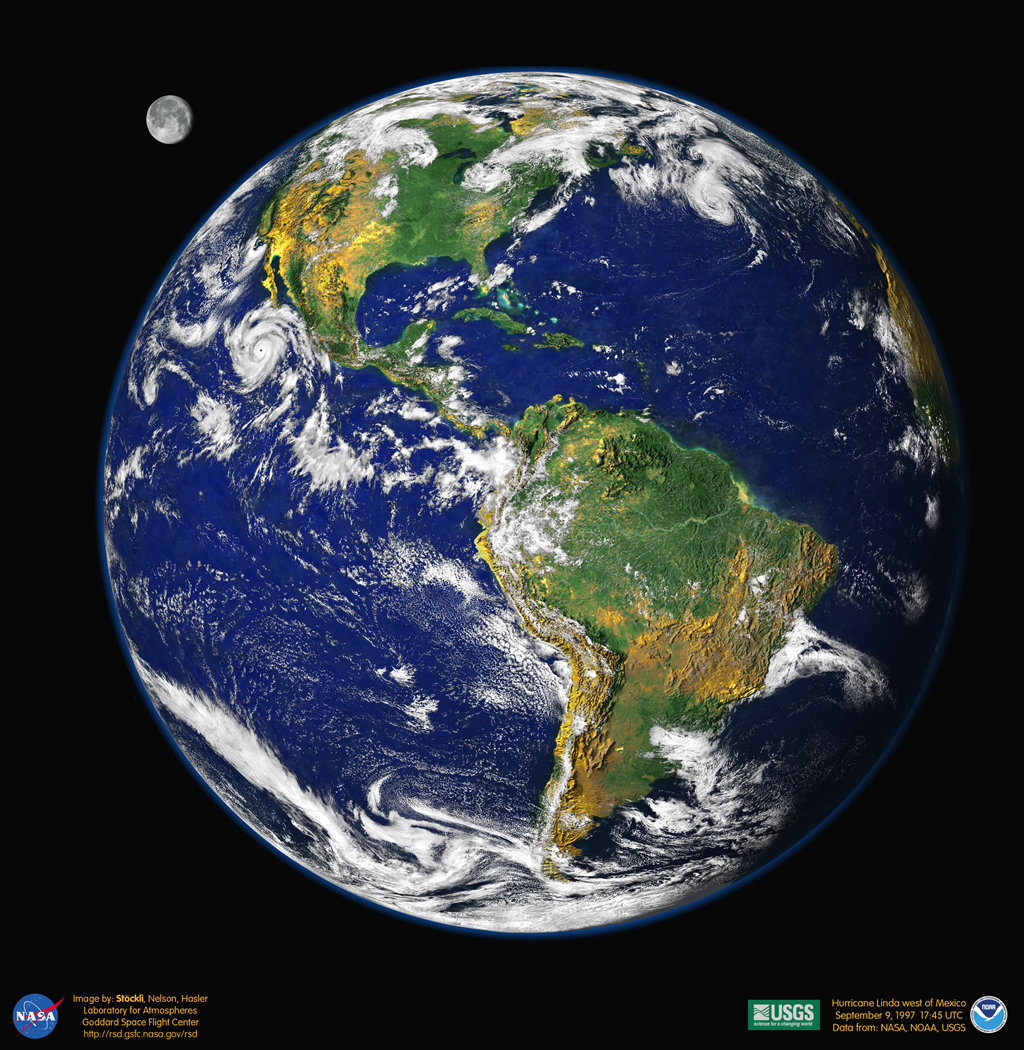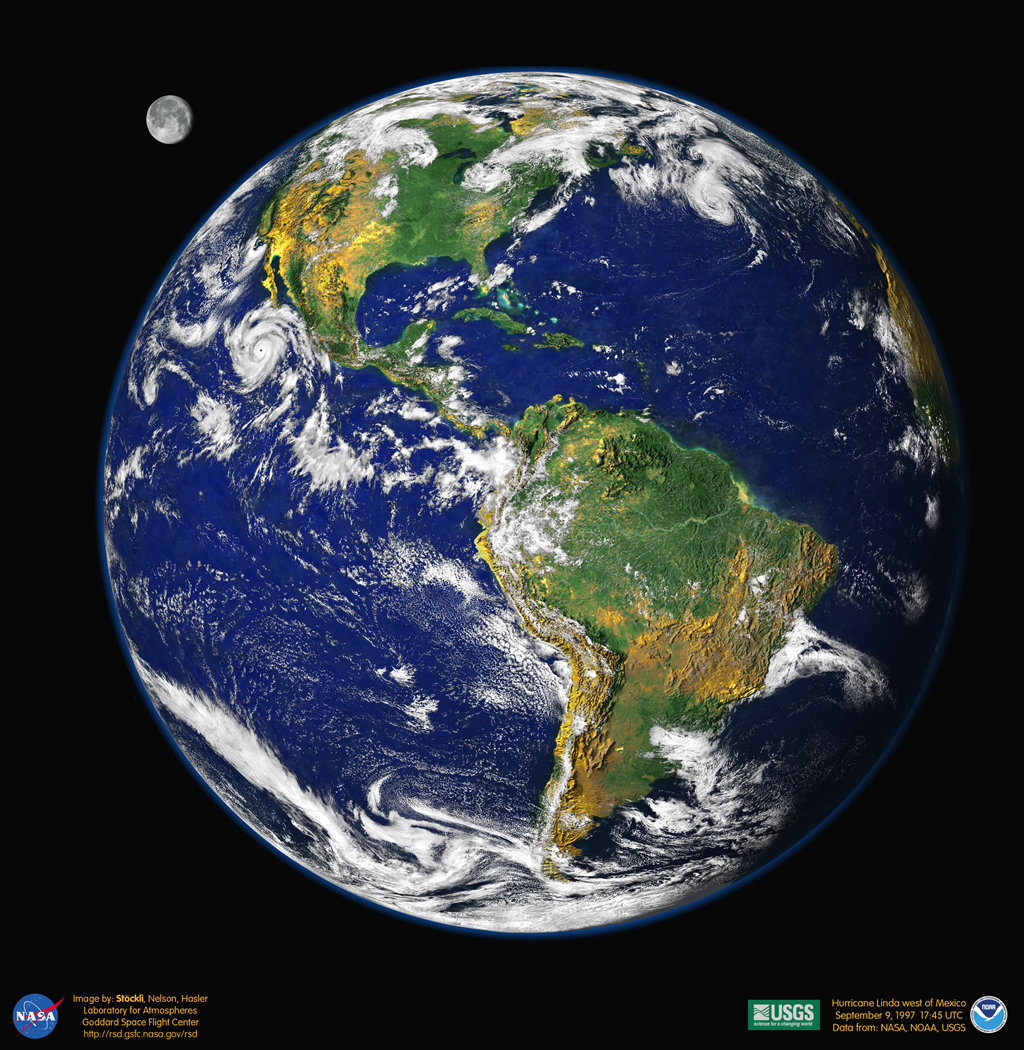
This newly released digital portrait of our planet is reminiscent of the Apollo-era pictures of the "big blue marble" Earth from space. To create it, researchers at Goddard Space Flight Center's Laboratory for Atmospheres combined data from a Geostationary Operational Environmental Satellite (GOES), the Sea-viewing Wide Field-of-view Sensor (SeaWiFS), and the Polar Orbiting Environmental Satellites (POES) with a USGS elevation model of Earth's topography. Stunningly detailed, the planet's western hemisphere is cast so that heavy vegetation is green and sparse vegetation is yellow, while the heights of mountains and depths of valleys have been exaggerated by 50 times to make vertical relief visible. Hurricane Linda is the dramatic storm off North America's west coast. And what about the Moon? The lunar image was reconstructed from GOES data and artistically rescaled for this visualization.
Este retrato digital de nuestro planeta, recientemente publicado, evoca las fotografías de la era Apolo de la "gran canica azul" que es la Tierra vista desde el espacio. Para crearlo, investigadores del Laboratorio de Atmósferas del Centro de Vuelo Espacial Goddard combinaron datos de un Satélite Ambiental Operacional Geoestacionario (GOES), el Sensor de Campo Visual Amplio para la Observación del Mar (SeaWiFS) y los Satélites Ambientales de Órbita Polar (POES), junto con un modelo de elevación topográfica de la Tierra elaborado por el USGS. Con un nivel de detalle asombroso, el hemisferio occidental del planeta ha sido representado de modo que la vegetación densa aparece en verde y la vegetación escasa en amarillo, mientras que las alturas de las montañas y las profundidades de los valles han sido exageradas 50 veces para hacer visible el relieve vertical. El huracán Linda es la dramática tormenta que se aprecia frente a la costa oeste de América del Norte. ¿Y qué hay de la Luna? La imagen lunar fue reconstruida a partir de datos del GOES y reescalada artísticamente para esta visualización.