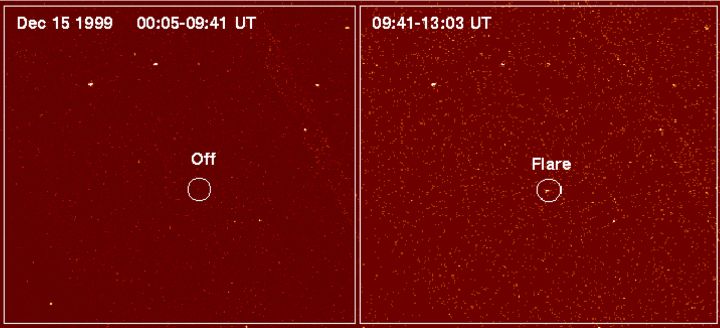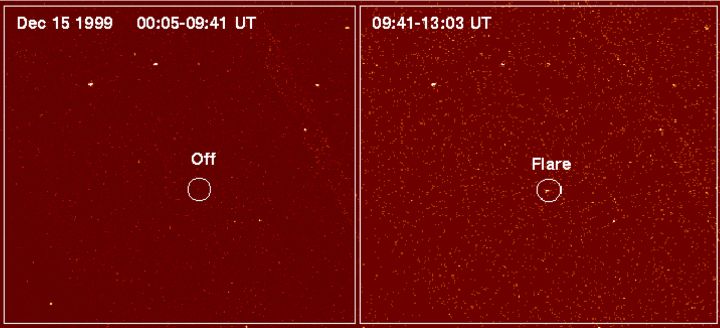
The tiny spot circled on the right actually represents a big astronomical discovery -- the first detected flare from a failed star. Failed stars, termed brown dwarfs in astronomers' parlance, are too low in mass to ignite nuclear hydrogen burning in their cores, yet still shine feebly as the energy from their gravitational collapse is converted to heat and light. In fact, the dim brown dwarf cataloged as LP944-20 is estimated to have only 6 percent the mass of the Sun (60 times the mass of Jupiter) and one-tenth the Sun's diameter. A mere 16 light-years distant in the southern constellation Fornax it is well studied, but this failed star recently startled astronomers by producing a flare visible at x-ray energies. The above Chandra X-ray Observatory images of the LP944-20 star field were recorded in December 1999. Showing nothing (left) for the first nine hours, the brown dwarf generated a significant x-ray flare during the final hours of the observation. How did a failed star produced such a high-energy flare? Magnetic fields twisted and broken by turbulent motions near the surface of the brown dwarf may be the culprit. Difficult to detect because they are otherwise faint, brown dwarf stars are believed to be common throughout the galaxy.
El pequeño punto señalado en la imagen de la derecha representa en realidad un gran descubrimiento astronómico: la primera llamarada detectada proveniente de una estrella fallida. Las estrellas fallidas, denominadas enanas marrones en la jerga de los astrónomos, poseen una masa demasiado reducida para encender la fusión nuclear del hidrógeno en sus núcleos, aunque brillan débilmente a medida que la energía de su colapso gravitacional se convierte en calor y luz. De hecho, se estima que la tenue enana marrón catalogada como LP 944-20 tiene apenas el 6 por ciento de la masa del Sol (60 veces la masa de Júpiter) y una décima parte del diámetro solar. Situada a tan solo 16 años luz de distancia en la constelación austral de Fornax, es un objeto bien estudiado; sin embargo, esta estrella fallida sorprendió recientemente a los astrónomos al producir una llamarada visible en energías de rayos X. Las imágenes del campo estelar de LP 944-20 obtenidas por el Observatorio de Rayos X Chandra, que se muestran arriba, fueron registradas en diciembre de 1999. Sin mostrar actividad alguna durante las primeras nueve horas (izquierda), la enana marrón generó una llamarada de rayos X significativa durante las horas finales de la observación. ¿Cómo produjo una estrella fallida una llamarada de tan alta energía? Los campos magnéticos retorcidos y fragmentados por los movimientos turbulentos cerca de la superficie de la enana marrón podrían ser los responsables. Difíciles de detectar debido a su débil brillo habitual, se cree que las enanas marrones son objetos comunes en toda la galaxia.