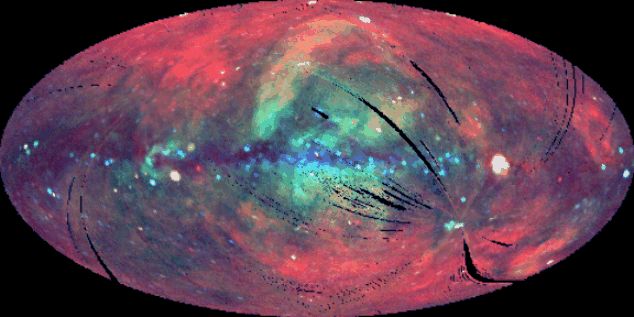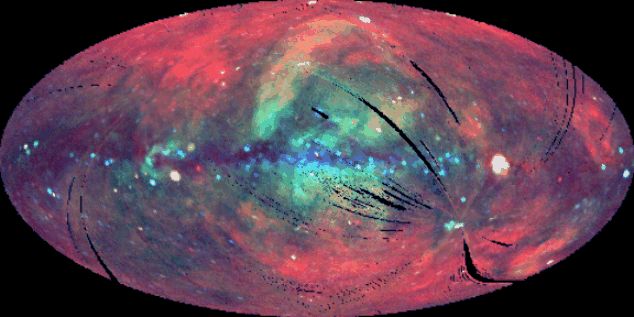
Launched in 1990, the orbiting ROSAT observatory explored the Universe by viewing the entire sky in x-rays -- photons with about 1,000 times more energy than visible light. This ROSAT survey produced the sharpest, most sensitive image of the x-ray sky to date. The all-sky image is shown with the plane of our Milky Way Galaxy running horizontally through the center. Both x-ray brightness and relative energy are represented with red, green, and blue colors indicating three x-ray energy ranges (from lowest to highest). Bright x-ray spots near the galactic plane are within our own Milky Way. The brightest region (right of center) is toward the Vela Pulsar and the Puppis supernova remnant. Bright sources beyond our Galaxy are also apparent, notably the Virgo cluster of galaxies (near top right) and the Large Magellanic Cloud (LMC). The LMC is easy to find here as several of the black stripes (blank areas caused by missing data) seem to converge on its position (lower right). Over large areas of the sky a general diffuse background of x-rays dominates. Hot gas in our own Galaxy provides much of this background and gives rise to the grand looping structures visible in the direction of the galactic center (image center). Unresolved extragalactic sources also add to this background, particularly above and below the plane. Despite the x-ray sky's exotic appearance, a very familiar feature is visible - the gas and dust clouds which line the plane of our galaxy absorb x-rays as well as optical light and produce the dark bands running through the galactic center.
Lanzado en 1990, el observatorio orbital ROSAT exploró el Universo observando el cielo completo en rayos X, fotones con aproximadamente 1.000 veces más energía que la luz visible. Este relevamiento de ROSAT produjo la imagen más nítida y sensible del cielo en rayos X hasta la fecha. La imagen de todo el cielo se muestra con el plano de nuestra Galaxia Vía Láctea discurriendo horizontalmente por el centro. Tanto el brillo en rayos X como la energía relativa están representados mediante los colores rojo, verde y azul, que indican tres rangos de energía de rayos X (de menor a mayor). Los puntos brillantes en rayos X cercanos al plano galáctico se encuentran dentro de nuestra propia Vía Láctea. La región más brillante (a la derecha del centro) apunta hacia el Púlsar de Vela y el remanente de supernova de Puppis. También se aprecian fuentes brillantes más allá de nuestra Galaxia, en particular el cúmulo de galaxias de Virgo (cerca de la esquina superior derecha) y la Gran Nube de Magallanes (GNM). La GNM es fácil de localizar aquí, ya que varias de las franjas negras (áreas en blanco causadas por datos faltantes) parecen converger en su posición (esquina inferior derecha). En grandes extensiones del cielo domina un fondo difuso general de rayos X. El gas caliente en nuestra propia Galaxia proporciona gran parte de este fondo y da origen a las grandes estructuras en forma de bucle visibles en la dirección del centro galáctico (centro de la imagen). Las fuentes extragalácticas no resueltas también contribuyen a este fondo, particularmente por encima y por debajo del plano. A pesar del exótico aspecto del cielo en rayos X, es posible distinguir un elemento muy familiar: las nubes de gas y polvo que bordean el plano de nuestra galaxia absorben los rayos X al igual que la luz óptica, y producen las bandas oscuras que atraviesan el centro galáctico.