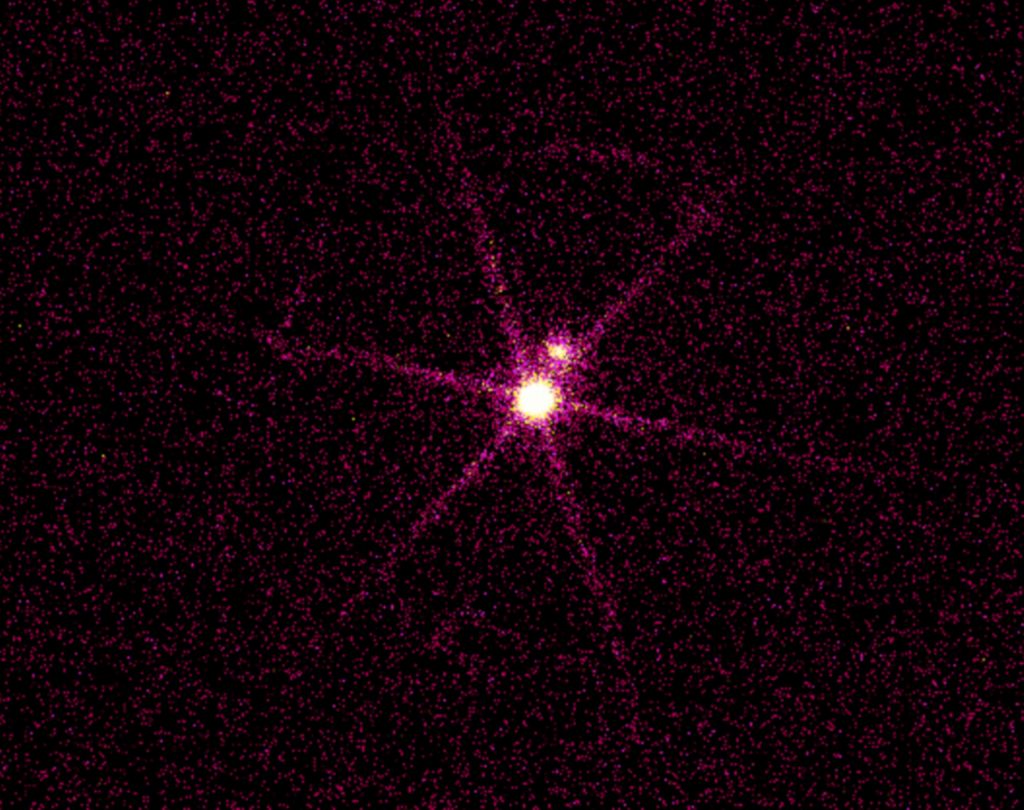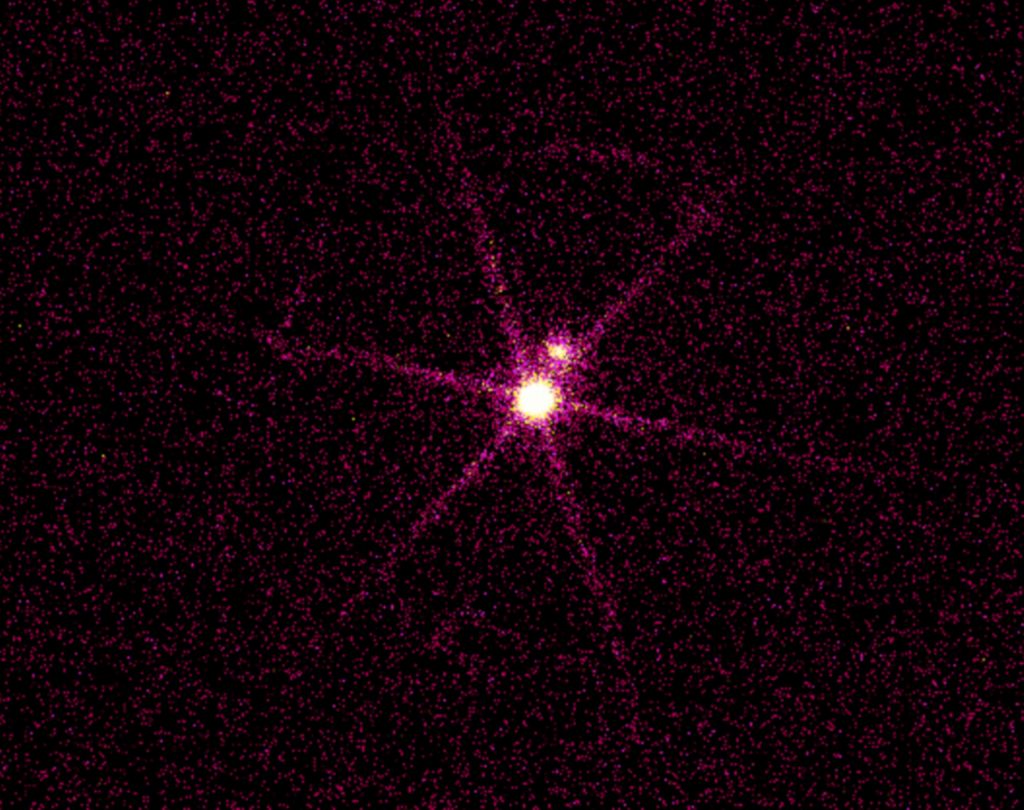
In visible light Sirius A (Alpha Canis Majoris) is the brightest star in the night sky, a closely watched celestial beacon throughout recorded history. Part of a binary star system only 8 light-years away, it was known in modern times to have a small companion star, Sirius B. Sirius B is much dimmer and appears so close to the brilliant Sirius A that it was not actually sighted until 1862, during Alvan Clark's testing of a large, well made optical refracting telescope. For orbiting x-ray telescopes, the Sirius situation is exactly reversed, though. A smaller but hotter Sirius B appears as the overwhelmingly intense x-ray source in this Chandra Observatory x-ray image (lines radiating from Sirius B are image artifacts). The fainter source seen at the position of Sirius A may be largely due to ultraviolet light from the star leaking into the x-ray detector. With a surface temperature of 25,000 kelvins, the mass of the Sun, and a radius just less than Earth's, Sirius B is the closest known white dwarf star. Can you guess what makes Sirius B like Neptune, the Sun's most distant gas giant planet? While still unseen, the presence of both celestial bodies was detected based on their gravitational influence alone ... making them early examples of dark matter.
En luz visible, Sirio A (Alpha Canis Majoris) es la estrella más brillante del cielo nocturno, un faro celeste estrechamente observado a lo largo de la historia registrada. Parte de un sistema binario ubicado a solo 8 años-luz de distancia, se sabía en tiempos modernos que tenía una pequeña estrella compañera, Sirio B. Sirio B es mucho más tenue y aparece tan cerca del brillante Sirio A que no fue detectada visualmente hasta 1862, durante las pruebas que realizaba Alvan Clark con un gran y bien construido telescopio refractor óptico. Sin embargo, para los telescopios de rayos X en órbita, la situación de Sirio es exactamente la inversa. La más pequeña pero más caliente Sirio B aparece como la fuente de rayos X de intensidad abrumadora en esta imagen de rayos X del Observatorio Chandra (las líneas que irradian desde Sirio B son artefactos de la imagen). La fuente más tenue observada en la posición de Sirio A puede deberse en gran medida a la luz ultravioleta de la estrella que se filtra hacia el detector de rayos X. Con una temperatura superficial de 25.000 kelvins, la masa del Sol y un radio apenas inferior al de la Tierra, Sirio B es la enana blanca más cercana conocida. ¿Puede adivinar qué tiene en común Sirio B con Neptuno, el planeta gaseoso más distante del Sistema Solar? Mientras aún permanecían sin ser observados directamente, la presencia de ambos cuerpos celestes fue detectada únicamente a partir de su influencia gravitacional... convirtiéndolos en ejemplos tempranos de materia oscura.