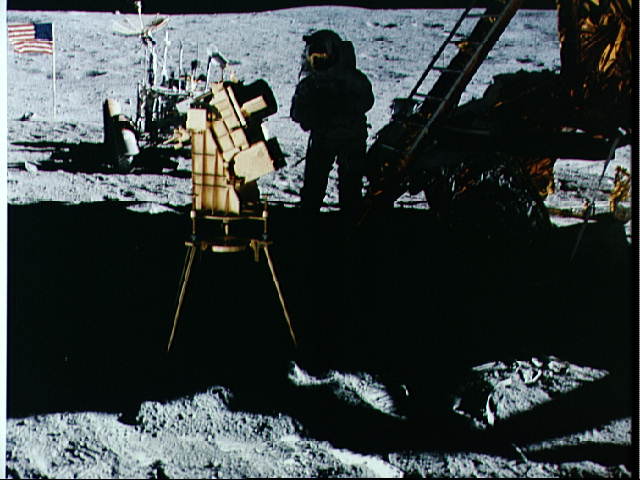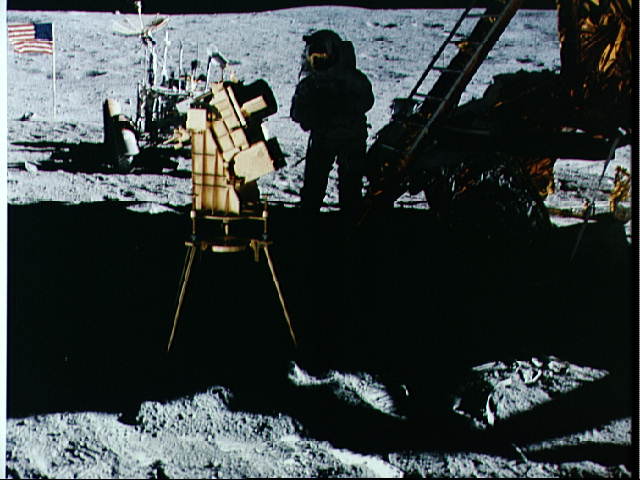
The first, and so far only, lunar astronomical observatory was deployed by the Apollo 16 crew in 1972. The Far Ultraviolet Camera / Spectrograph used a 3-inch diameter Schmidt telescope to photograph the Earth, nebulae, star clusters, and the Large Magellanic Cloud. The tripod mounted astronomical equipment is seen above, placed in the shadow of the Lunar Module (right) so it would not overheat. Also in the shadow is astronaut Charles Duke with the lunar rover in the background. The Far Ultraviolet Camera took pictures in ultraviolet light which would normally be blocked by the Earth's atmosphere. It was created by George Carruthers (NRL), had a field of view of twenty degrees, and could detect stars having visual magnitude brighter than eleven. One hundred seventy-eight images were recorded in a film cartridge which the astronauts returned to Earth. The observatory still stands on the Moon today.
El primero, y hasta ahora único, observatorio astronómico lunar fue desplegado por la tripulación del Apollo 16 en 1972. La Cámara/Espectrógrafo de Ultravioleta Lejano utilizó un telescopio Schmidt de 3 pulgadas de diámetro para fotografiar la Tierra, nebulosas, cúmulos estelares y la Gran Nube de Magallanes. El equipo astronómico montado sobre un trípode se observa en la imagen, colocado a la sombra del Módulo Lunar (a la derecha) para evitar su sobrecalentamiento. También en la sombra se encuentra el astronauta Charles Duke con el vehículo lunar al fondo. La Cámara de Ultravioleta Lejano tomó imágenes en luz ultravioleta que normalmente sería bloqueada por la atmósfera terrestre. Fue creada por George Carruthers (NRL), tenía un campo de visión de veinte grados y podía detectar estrellas con magnitud visual más brillante que once. Ciento setenta y ocho imágenes fueron registradas en un cartucho de película que los astronautas trajeron de regreso a la Tierra. El observatorio permanece aún hoy en pie sobre la Luna.