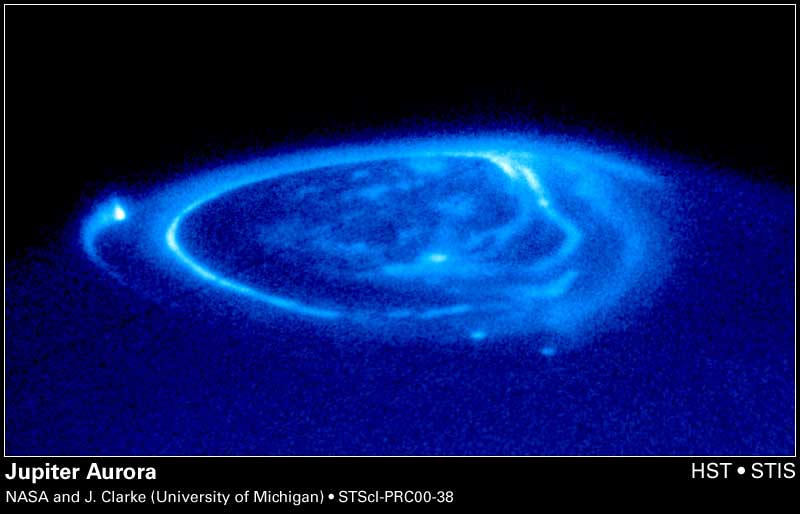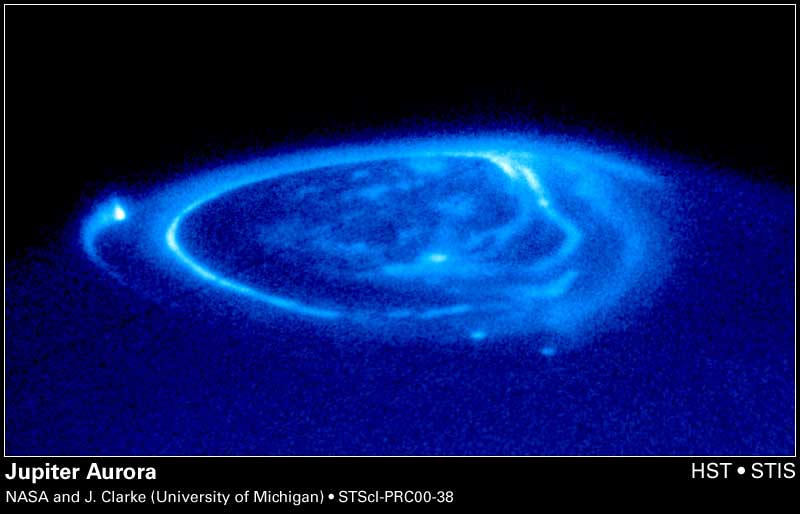
Jupiter has aurorae. Like Earth, the magnetic field of the gas giant funnels charged particles released from the Sun onto the poles. As these particles strike the atmosphere, electrons are temporarily knocked away from existing gas molecules. Electric force attracts these electrons back. As the electrons recombine to remake neutral molecules, auroral light is emitted. In the above recently released photograph by the Hubble Space Telescope taken in ultraviolet light, the aurorae appear as annular sheets around the pole. Unlike Earth's aurorae, Jupiter's aurorae include several bright streaks and dots. These marks are caused by magnetic flux tubes connecting Jupiter to its largest moons. Specifically, Io caused the bright streak on the far left, Ganymede caused the bright dot below center, and Europa caused the dot to its right.
Júpiter tiene auroras. Al igual que la Tierra, el campo magnético del gigante gaseoso canaliza las partículas cargadas liberadas por el Sol hacia los polos. Cuando estas partículas golpean la atmósfera, los electrones son temporalmente arrancados de las moléculas de gas existentes. La fuerza eléctrica atrae a estos electrones de regreso. A medida que los electrones se recombinan para formar moléculas neutras nuevamente, se emite luz auroral. En la fotografía tomada recientemente por el Telescopio Espacial Hubble en luz ultravioleta mostrada arriba, las auroras aparecen como anillos luminosos alrededor del polo. A diferencia de las auroras terrestres, las auroras de Júpiter incluyen varias franjas y puntos brillantes. Estas marcas son causadas por tubos de flujo magnético que conectan a Júpiter con sus lunas más grandes. Específicamente, Io causó la franja brillante en el extremo izquierdo, Ganímedes causó el punto brillante debajo del centro, y Europa causó el punto a su derecha.