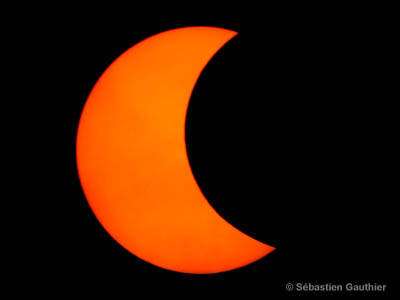
Today the Sun reaches its southernmost point in planet Earth's sky at 13:37 UT. This celestial event is known as a solstice, marking the beginning of Summer in the Southern Hemisphere and Winter in the North. But this year, the solstice will be followed, on December 25th, by another geocentric celestial event -- the last eclipse of the millennium! The Christmas day eclipse will only be a partial one as the silhouetted disk of the Moon obscures the Sun's edge. Visible from much of Canada, The United States and Mexico, the appearance of the partially eclipsed Sun might remind you of the last holiday cookie you took a bite from. Still, the exact timing and degree of the eclipse will depend very much on your location. This image, from an annular eclipse in 1994, shows the lunar disk covering around 55% of the Sun's diameter. It is representative of what could be seen from Washington D. C. during the December 25 eclipse maximum which, for that location, occurs at 12:41 PM ET. As always, if you view the eclipse be extremely careful to protect your eyes.
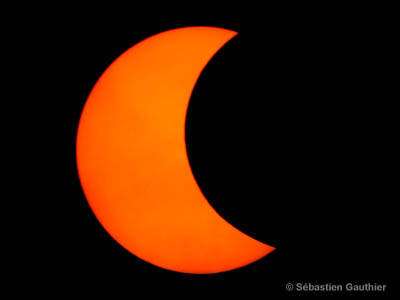
Hoy el Sol alcanza su punto más austral en el cielo del planeta Tierra a las 13:37 UT. Este evento celestial se conoce como solsticio, y marca el inicio del Verano en el Hemisferio Sur y del Invierno en el Norte. Pero este año, el solsticio será seguido, el 25 de diciembre, por otro evento celestial geocéntrico: ¡el último eclipse del milenio! El eclipse del día de Navidad será únicamente parcial, ya que el disco en silueta de la Luna oscurecerá el borde del Sol. Visible desde gran parte de Canadá, los Estados Unidos y México, la apariencia del Sol parcialmente eclipsado podría recordarle a la última galleta navideña de la que tomó un mordisco. Aun así, el momento exacto y el grado del eclipse dependerán en gran medida de su ubicación. Esta imagen, tomada durante un eclipse anular en 1994, muestra el disco lunar cubriendo alrededor del 55% del diámetro del Sol. Es representativa de lo que podría observarse desde Washington D. C. durante el máximo del eclipse del 25 de diciembre, que para esa ubicación ocurre a las 12:41 PM ET. Como siempre, si observa el eclipse tenga extremo cuidado en proteger sus ojos.