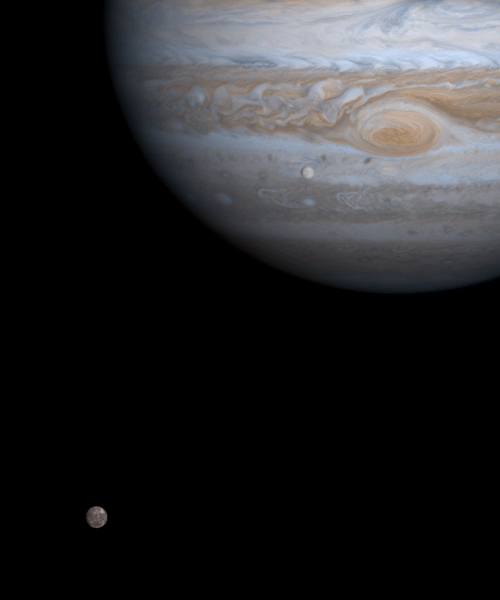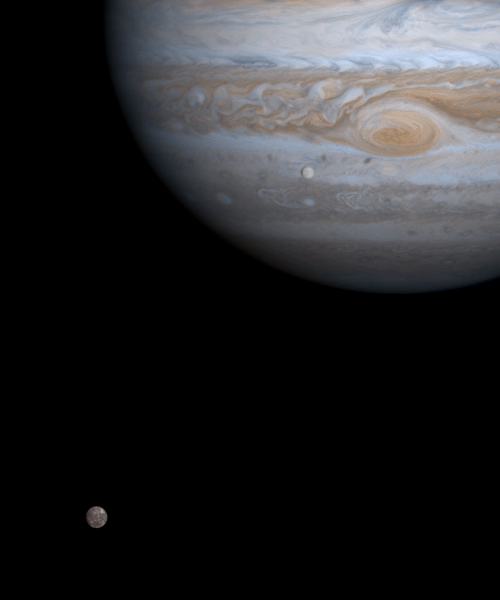
As the robot Cassini spacecraft rounds Jupiter on its way toward Saturn, it has taken a sequence of images of the gas giant with its four largest moons. Previously released images have highlighted Ganymede and Io. Pictured above are the two remaining Galilean satellites: Europa and Callisto. Europa is the bright moon superposed near Jupiter's Great Red Spot, while Callisto is the dark moon near the frame edge. Callisto is so dark that it would be hard to see here if its brightness was not digitally enhanced. Recent evidence indicates that both moons hold salt-water seas under surface ice that might be home to extra-terrestrial life. By noting the times that moons disappeared and reappeared behind Jupiter in 1676, Ole Roemer was able to make the first accurate estimation of the speed of light.
Mientras la sonda robótica Cassini orbita Júpiter en su camino hacia Saturno, ha capturado una secuencia de imágenes del gigante gaseoso junto con sus cuatro lunas más grandes. Las imágenes previamente publicadas han destacado a Ganímedes e Ío. En la imagen superior se muestran los dos satélites galileanos restantes: Europa y Calisto. Europa es la luna brillante superpuesta cerca de la Gran Mancha Roja de Júpiter, mientras que Calisto es la luna oscura cerca del borde del marco. Calisto es tan oscura que sería difícil verla aquí si su brillo no hubiera sido mejorado digitalmente. Evidencia reciente indica que ambas lunas albergan mares de agua salada bajo el hielo superficial que podrían ser hogar de vida extraterrestre. Al observar los tiempos en que las lunas desaparecían y reaparecían detrás de Júpiter en 1676, Ole Roemer fue capaz de hacer la primera estimación precisa de la velocidad de la luz.