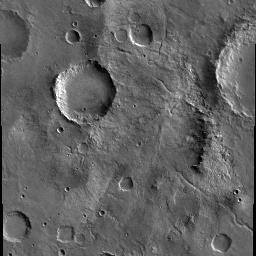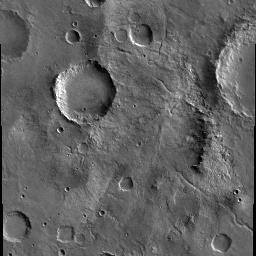
The large Martian crater above just left of center: is this a fresh crater, a degraded crater, or a ghost crater? Complex image recognition tasks like these are currently done more reliably by a human than a computer. Additionally, there are so many craters on Mars that NASA just doesn't have enough people to classify them all! Therefore, you can help humanity's understanding of the surface of Mars by volunteering to classify craters. All you need for this pilot study is a proper web browser and a mouse. If asked to classify the above crater, you might best respond that it appears relatively fresh, as it exhibits a sharp rim and a well-preserved interior. Degraded craters are typically older and have their rims more rounded, while "ghost craters" are the oldest of all and only faintly discernable.
El gran cráter marciano anterior, justo a la izquierda del centro: ¿es un cráter fresco, un cráter degradado o un cráter fantasma? Tareas complejas de reconocimiento de imágenes como estas actualmente las realizan con mayor fiabilidad los humanos que las computadoras. Además, hay tantos cráteres en Marte que la NASA simplemente no tiene suficientes personas para clasificarlos todos. Por lo tanto, puedes ayudar a la comprensión de la humanidad sobre la superficie de Marte ofreciéndote como voluntario para clasificar cráteres. Todo lo que necesitas para este estudio piloto es un navegador web apropiado y un ratón. Si se te pide clasificar el cráter anterior, podrías responder mejor que parece relativamente fresco, ya que exhibe un borde nítido e un interior bien preservado. Los cráteres degradados son típicamente más antiguos y tienen sus bordes más redondeados, mientras que los "cráteres fantasma" son los más antiguos de todos y apenas son discernibles.