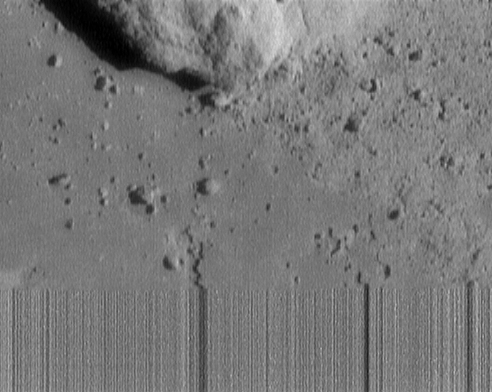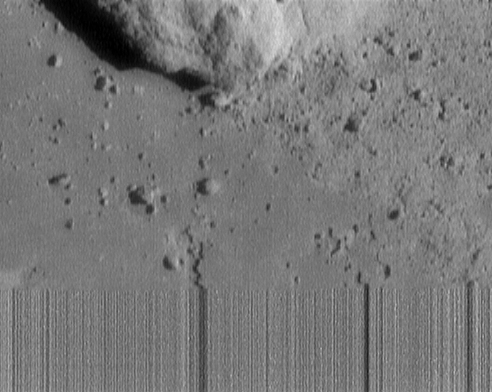
Yesterday NEAR-Shoemaker became the first spacecraft to land on an asteroid and send signals back from its surface. Since the robot spacecraft was not designed for such a contingency, the success of the landing on asteroid 433 Eros was not assured. Shown above is the last picture taken by NEAR-Shoemaker before its touchdown. The streaking on the lower part of the image was caused by the loss of telemetry as the satellite impacted the surface. The image was taken 130 meters above the surface and spans 6 meters across. Rocks as small as a human hand are visible. As engineers continue to try to communicate with the beached car-sized spacecraft, scientists will work to understand features visible in the highest resolution photographs ever taken of an asteroid.
Ayer, NEAR-Shoemaker se convirtió en la primera nave espacial en aterrizar en un asteroide y enviar señales desde su superficie. Dado que la nave robótica no fue diseñada para tal contingencia, el éxito del aterrizaje en el asteroide 433 Eros no estaba garantizado. La imagen que se muestra arriba es la última fotografía tomada por NEAR-Shoemaker antes de su impacto. Las rayaduras en la parte inferior de la imagen fueron causadas por la pérdida de telemetría cuando el satélite impactó la superficie. La imagen fue tomada a 130 metros sobre la superficie y abarca 6 metros de ancho. Se pueden observar rocas tan pequeñas como una mano humana. Mientras los ingenieros continúan intentando comunicarse con la nave espacial del tamaño de un automóvil varada en la superficie, los científicos trabajarán para comprender las características visibles en las fotografías de más alta resolución jamás tomadas de un asteroide.