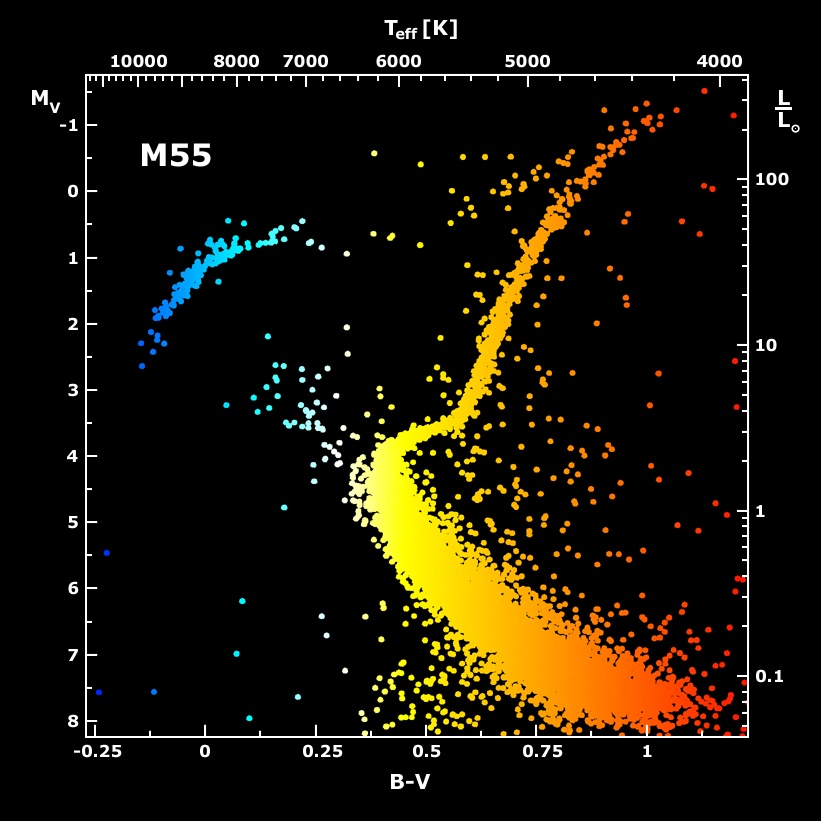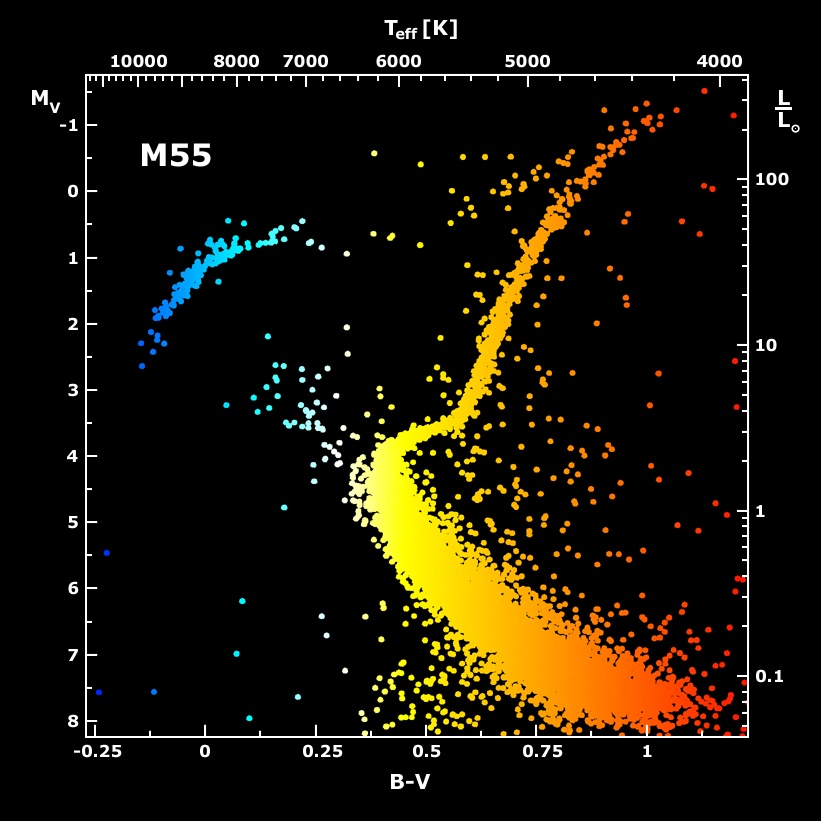
This color "picture" of globular star cluster M55 may not look like any star cluster you've ever seen. Still, it shows a most fundamental view for students of stellar astronomy. In the picture, a Color Magnitude Diagram (CMD), M55's individual stars are represented as dots whose color indicates relative temperature, red (cool) to blue (hot). Position in the CMD does not correspond to a star's location in the sky, though. Instead, it corresponds to a measured astronomical color, (B-V color) read off the bottom scale, and a brightness in magnitudes (M) on the left hand scale. The temperature for each star can also be found by reading the equivalent scale at the top, where the Sun would have a temperature of 6,000 kelvins (K). Brightness relative to the Sun's luminosity (Sun = 1) is given on the scale at the right. The globular cluster stars clearly fall into distinct groups dramatically visible in this CMD. The broad swath extending diagonally from the lower right is the cluster's main sequence. A sharp turn toward the upper right hand corner follows the red giant branch while the blue giants are found grouped in the upper left. M55's stars were formed at the same time and at first were all located along the main sequence by mass, lower mass stars at the lower right. Over time, higher mass stars have evolved off the main sequence into red, then blue giants and beyond. The exact position of the sharp turn-off from the main sequence to the red giant branch measures the cluster's age.
Esta "imagen" en color del cúmulo globular M55 puede no parecer ningún cúmulo de estrellas que hayas visto antes. Sin embargo, muestra una perspectiva fundamental para los estudiosos de la astronomía estelar. En la imagen, un Diagrama Color-Magnitud (DCM), las estrellas individuales de M55 se representan como puntos cuyo color indica la temperatura relativa, rojo (frío) a azul (caliente). La posición en el DCM no corresponde a la ubicación de una estrella en el cielo, sin embargo. En su lugar, corresponde a un color astronómico medido, (color B-V) que se lee en la escala inferior, y a un brillo en magnitudes (M) en la escala del lado izquierdo. La temperatura de cada estrella también se puede encontrar leyendo la escala equivalente en la parte superior, donde el Sol tendría una temperatura de 6.000 kelvin (K). El brillo relativo a la luminosidad del Sol (Sol = 1) se proporciona en la escala de la derecha. Las estrellas del cúmulo globular se agrupan claramente en grupos distintos dramáticamente visibles en este DCM. La franja amplia que se extiende diagonalmente desde la esquina inferior derecha es la secuencia principal del cúmulo. Un giro pronunciado hacia la esquina superior derecha sigue la rama de gigantes rojas, mientras que los gigantes azules se encuentran agrupados en la esquina superior izquierda. Las estrellas de M55 se formaron al mismo tiempo y al principio estaban todas ubicadas a lo largo de la secuencia principal por masa, estrellas de menor masa en la esquina inferior derecha. Con el tiempo, las estrellas de mayor masa han evolucionado fuera de la secuencia principal hacia gigantes rojos, luego azules y más allá. La posición exacta del giro pronunciado de la secuencia principal hacia la rama de gigantes rojas mide la edad del cúmulo.