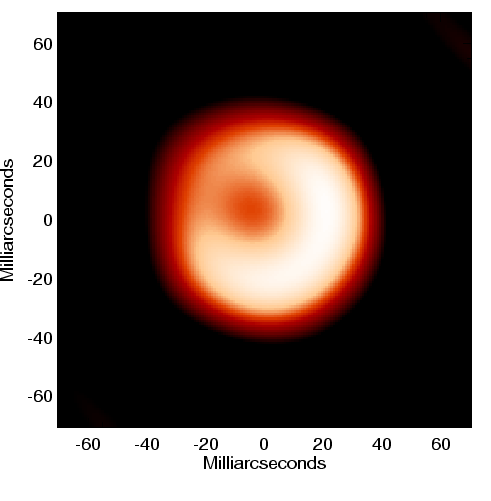
You'd need a really big cup of coffee with this doughnut ... because the hole in the middle is about a billion kilometers across. Centered on the Sun, a circle that size would lie between the orbits of Mars and Jupiter. In fact, this doughnut is known to surround a massive newborn star cataloged as LkHa 101 which lies in the constellation Perseus. Imaged in infrared light, the tantalizing torus-shaped cloud of gas and dust is slightly tilted to our view. The cloud's material may well be the ingredients for the formation of a distant solar system. A bright source of ultraviolet light, the hot young star itself is much fainter in the infrared and so not visible in this picture. Still, the star's presence is indicated as its intense stellar wind and radiation has apparently carved out the doughnut's hole. This premier close-up of a stellar system in formation was accomplished by adapting a powerful observational technique called interferometry to planet Earth's largest single mirror telescope, the 10 meter Keck.
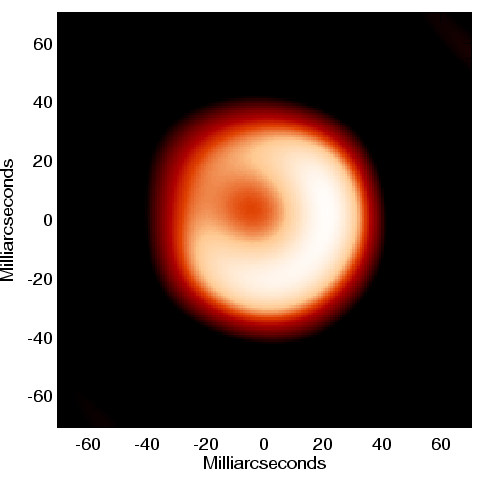
Necesitarías una taza de café muy grande con esta rosquilla... porque el agujero en el centro tiene aproximadamente mil millones de kilómetros de diámetro. Un círculo de ese tamaño centrado en el Sol se encontraría entre las órbitas de Marte y Júpiter. De hecho, esta rosquilla es conocida por rodear una estrella joven y masiva catalogada como LkHa 101, que se encuentra en la constelación de Perseo. Imagen en luz infrarroja, la nube tentadora de forma toroidal de gas y polvo está ligeramente inclinada respecto a nuestra visión. La materia de la nube podría ser los ingredientes para la formación de un sistema solar distante. Fuente brillante de luz ultravioleta, la estrella joven y caliente en sí es mucho más tenue en el infrarrojo y, por lo tanto, no es visible en esta imagen. Sin embargo, la presencia de la estrella se indica claramente, ya que su intenso viento estelar y radiación han excavado claramente el agujero de la rosquilla. Esta imagen de primer plano de un sistema estelar en formación fue lograda adaptando una poderosa técnica de observación llamada interferometría al telescopio de espejo único más grande de la Tierra, el Keck de 10 metros.