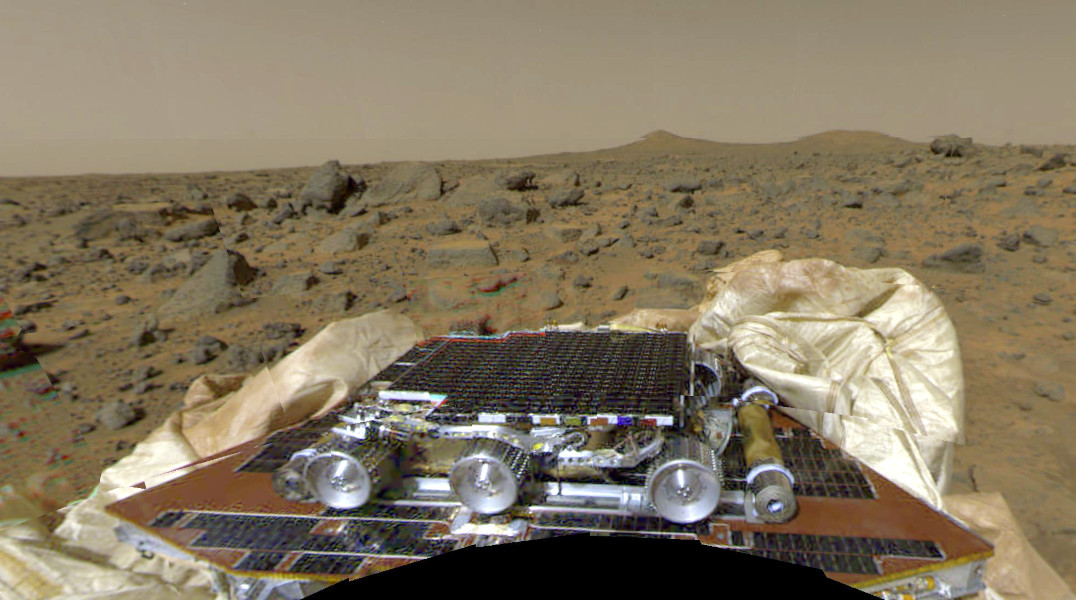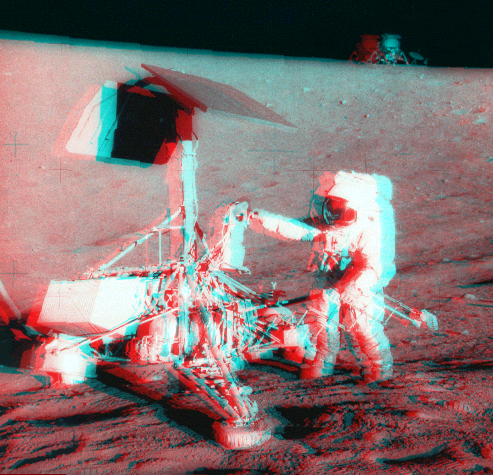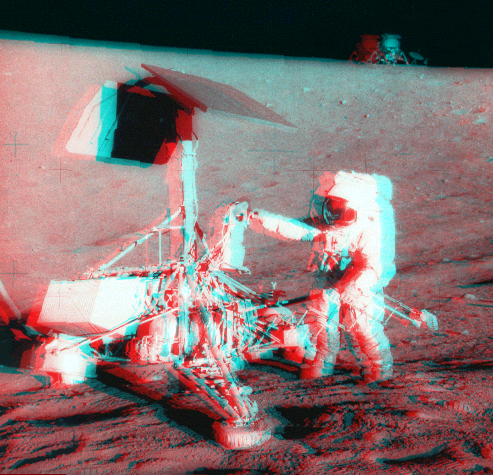
Put on your red/blue glasses and gaze into this dramatic stereo view from the surface of the Moon! Inspired by last Saturday's APOD, experimentor Patrick Vantuyne offers this stereo rendering of Apollo 12 astronaut Pete Conrad visiting the Surveyor 3 spacecraft in November of 1969. To create the stereo image, Vantuyne carefully combed through the pictures available for downloading from the Apollo Lunar Surface Journal web site to find two which would make an appropriate "stereo pair". He found a pair that depicted the captivating scene from only slightly different viewpoints, approximating the separation between human eyes. Combining the two separate pictures, one tinted red and the other blue-green, with the correct offset, produces the stereo effect when viewed using red/blue glasses, the red filter covering the left eye. The color filters guide each eye to see only the picture with the correct corresponding viewpoint and the brain interprets the result as normal stereo vision. (Editor's note: While you've got those glasses on ... other web sources of astronomy and space science stereo images include the Mars Path Finder archive and a 3D Tour of the Solar System.)
¡Ponte tus gafas rojas/azules y contempla esta dramática vista estereoscópica desde la superficie de la Luna! Inspirado por la imagen APOD del pasado sábado, el experimentador Patrick Vantuyne ofrece esta representación estereoscópica del astronauta de Apollo 12, Pete Conrad, visitando la nave espacial Surveyor 3 en noviembre de 1969. Para crear la imagen estereoscópica, Vantuyne revisó cuidadosamente las fotos disponibles para descargar del sitio web del Apollo Lunar Surface Journal con el fin de encontrar dos que formaran un par estereoscópico adecuado. Encontró un par que mostraba la escena cautivadora desde puntos de vista ligeramente diferentes, aproximando la separación entre los ojos humanos. Al combinar las dos imágenes separadas, una teñida de rojo y la otra de azul-verde, con el desplazamiento correcto, se produce el efecto estereoscópico al verla con gafas rojas/azules, con el filtro rojo cubriendo el ojo izquierdo. Los filtros de color guían a cada ojo para ver solo la imagen con el punto de vista correspondiente y el cerebro interpreta el resultado como visión estereoscópica normal. (Nota del editor: Mientras aún llevas puestas esas gafas... otras fuentes en la web de imágenes estereoscópicas de astronomía y ciencia espacial incluyen el archivo del Mars Pathfinder y un Tour 3D del Sistema Solar.)