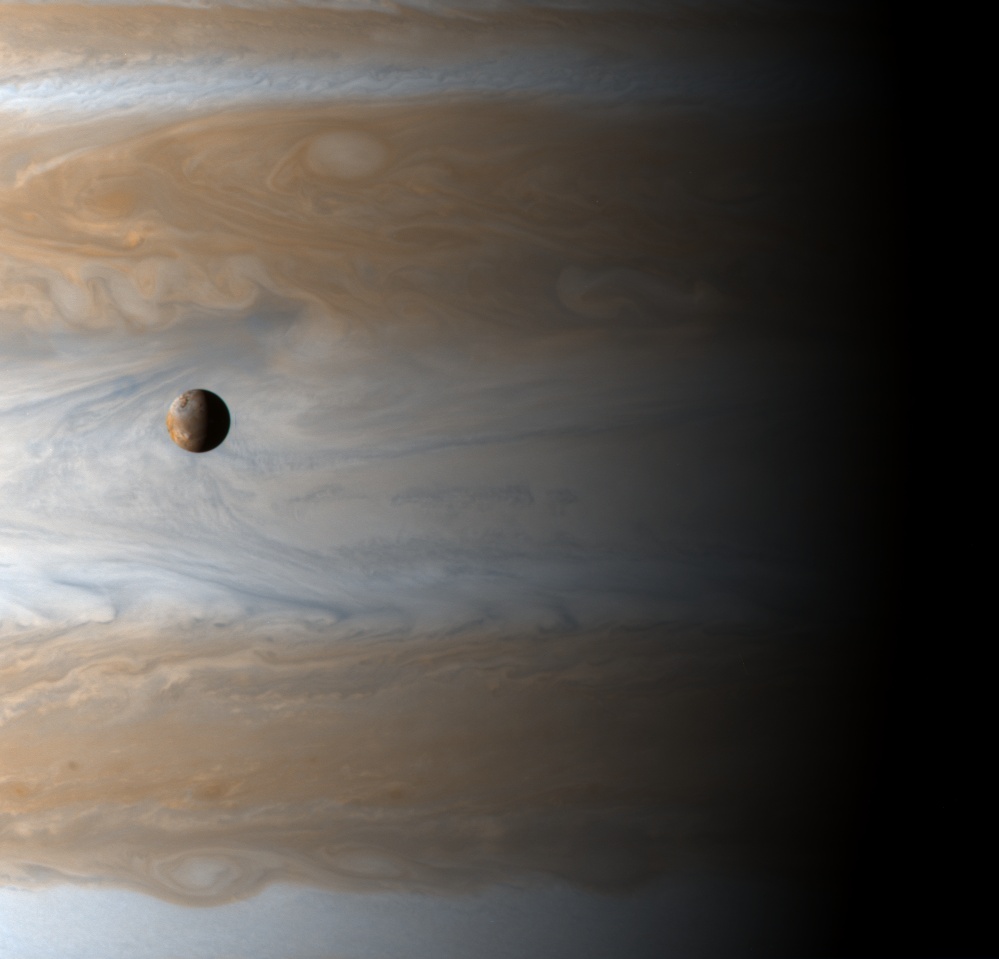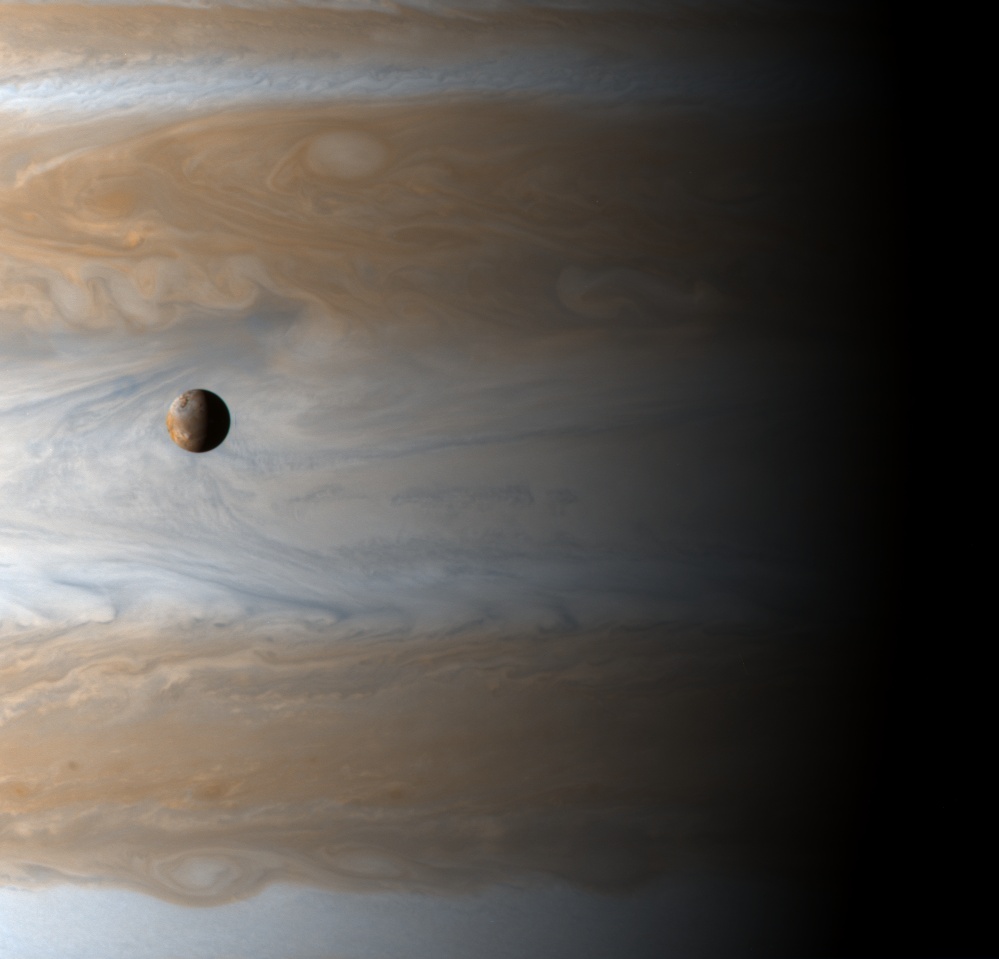
How big is the Jovian moon Io? The most volcanic body in the Solar System, Io (usually pronounced "EYE-oh") is 3,600 kilometers in diameter, about the size of planet Earth's single large natural satellite. Gliding past Jupiter at the turn of the millennium, the Cassini spacecraft captured this awe inspiring view of active Io with the largest gas giant as a backdrop, offering a stunning demonstration of the ruling planet's relative size. Although in the picture Io appears to be located just in front of the swirling Jovian clouds, Io hurtles around its orbit once every 42 hours at a distance of 420,000 kilometers or so from the center of Jupiter. That puts it nearly 350,000 kilometers above Jupiter's cloud tops, roughly equivalent to the distance between Earth and Moon. The Cassini spacecraft itself was about 10 million kilometers from Jupiter when recording the image data.
¿Qué tamaño tiene la luna joviana Io? Io, el cuerpo más volcánico del Sistema Solar, tiene un diámetro de 3.600 kilómetros, aproximadamente del tamaño de la única gran luna natural del planeta Tierra. Al deslizarse junto a Júpiter a principios del nuevo milenio, la nave espacial Cassini capturó esta impresionante imagen de Io activo, con el gigante gaseoso más grande como fondo, ofreciendo una demostración asombrosa del tamaño relativo del planeta dominante. Aunque en la imagen Io parece estar justo delante de las nubes en remolino de Júpiter, Io completa una órbita cada 42 horas a una distancia de unos 420.000 kilómetros del centro de Júpiter. Eso la sitúa a unos 350.000 kilómetros por encima de las nubes de Júpiter, aproximadamente equivalente a la distancia entre la Tierra y la Luna. La nave espacial Cassini misma se encontraba a unos 10 millones de kilómetros de Júpiter cuando registró los datos de la imagen.