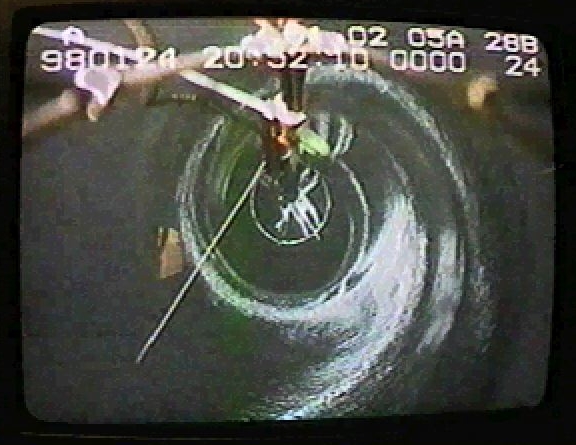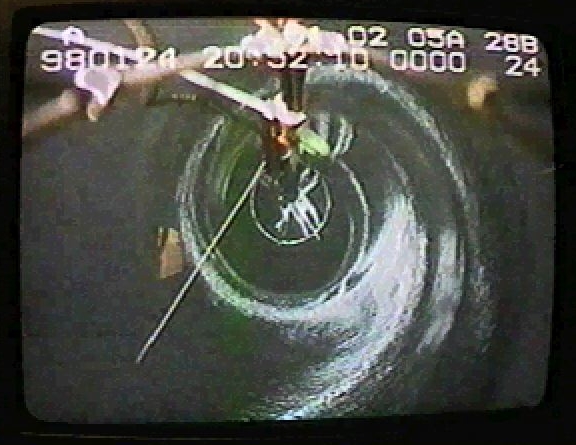
Scientists are melting holes in the bottom of the world. In fact, several holes have been melted near the South Pole, and they are now being used as astronomical observatories. Astronomers with the Antarctic Muon and Neutrino Detector Array (AMANDA) lower into each vertical lake a string knotted with basketball-sized light detectors. The water in each hole soon refreezes. The detectors are sensitive to blue light emitted in the surrounding clear ice. Such light is expected from ice collisions with high-energy neutrinos emitted by objects or explosions out in the universe. The above picture was taken 750 meters below the surface looking down into the abyss. Instruments were lowered down past 2000 meters. Data from AMANDA is currently being collected and analyzed.
Los científicos están taladrando agujeros en el fondo del mundo. De hecho, varios agujeros han sido taladrados cerca del Polo Sur, y ahora se utilizan como observatorios astronómicos. Los astrónomos del Array de Detección de Muones y Neutrinos Antártico (AMANDA) introducen en cada lago vertical una cuerda con nudos que llevan detectores de luz del tamaño de una pelota de baloncesto. El agua de cada agujero se vuelve a congelar rápidamente. Los detectores son sensibles a la luz azul emitida en el hielo transparente que los rodea. Esta luz se espera que provenga de colisiones en el hielo con neutrinos de alta energía emitidos por objetos o explosiones en el universo. La imagen de arriba fue tomada a 750 metros bajo la superficie, mirando hacia el abismo. Los instrumentos fueron bajados más allá de los 2000 metros. Actualmente se están recopilando y analizando datos de AMANDA.