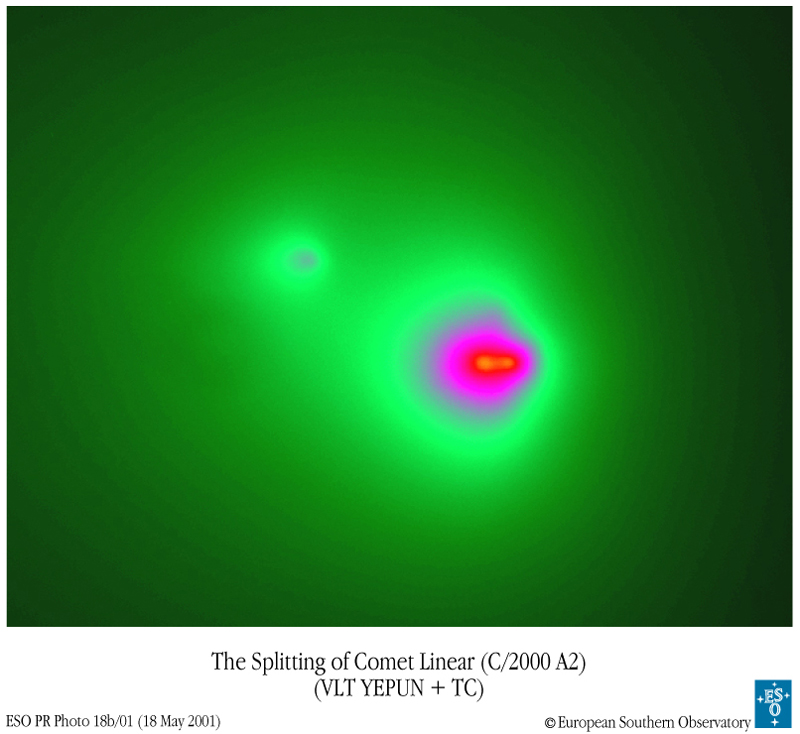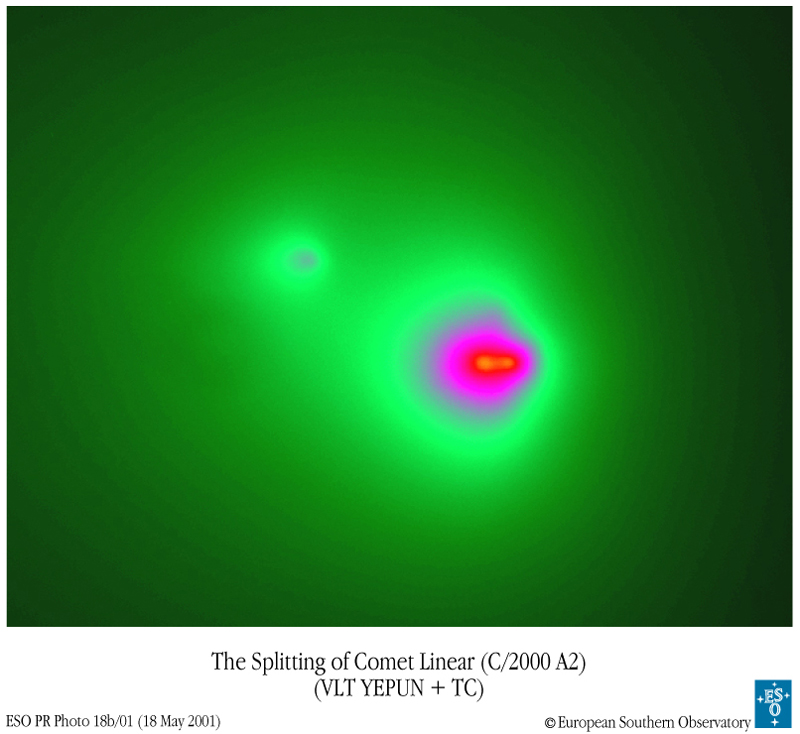
Last year, a different comet LINEAR (C/1999 S4) broke up. This year, a comet first imaged by the Lincoln Near Asteroid Research (LINEAR) telescope in New Mexico on 2001 January 3, is also breaking up. This new Comet LINEAR (C/2001 A2) unexpectedly brightened to the edge of naked-eye visiblilty a few weeks ago when its nucleus broke in two. Observations taken just last week now indicate that one of the two remaining nuclear fragments has again fragmented. The first piece to break off is visible on the upper left of the above false-color image by a Very Large Telescope, while additional fragmentation is inferred from the brightness and elongation of the spot on the lower right. When a comet nucleus splits, new surfaces are exposed and previously trapped ice and gas are released that evaporate and brighten in the energetic sunlight. Comet LINEAR may remain visible with little or no optical aid into early June. In contrast, at least two other much dimmer Comet LINEARs discovered recently appear stable.
El año pasado, un cometa diferente de LINEAR (C/1999 S4) se fragmentó. Este año, un cometa que fue fotografiado por primera vez por el telescopio Lincoln Near Asteroid Research (LINEAR) en Nuevo México el 3 de enero de 2001, también se está desgajando. Este nuevo cometa LINEAR (C/2001 A2) se aclaró inesperadamente hasta el borde de la visibilidad a simple vista hace unas semanas cuando su núcleo se rompió en dos. Observaciones tomadas solo la semana pasada indican ahora que uno de los dos fragmentos nucleares restantes se ha fragmentado nuevamente. El primer fragmento que se separó es visible en la esquina superior izquierda de la imagen en falso color mostrada arriba, tomada por el Very Large Telescope, mientras que se infiere una fragmentación adicional a partir del brillo y la elongación del punto en la esquina inferior derecha. Cuando un núcleo de cometa se divide, se exponen nuevas superficies y se liberan hielo y gas previamente atrapados que se evaporan y se aclaran bajo la luz solar energética. El cometa LINEAR podría permanecer visible sin necesidad de ayuda óptica alguna hasta principios de junio. En contraste, al menos otros dos cometas LINEAR mucho más tenues descubiertos recientemente parecen estables.