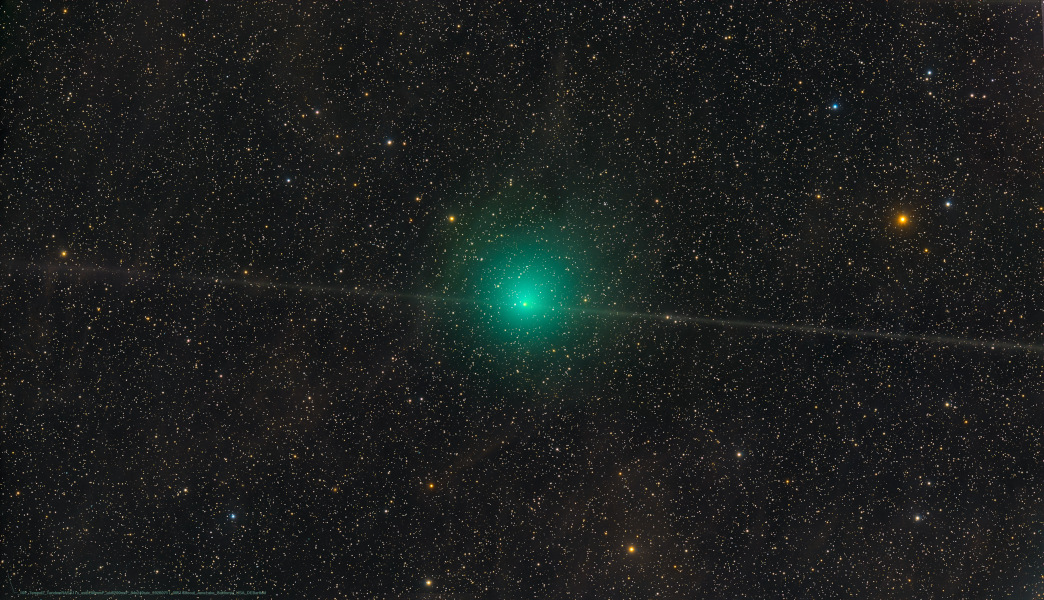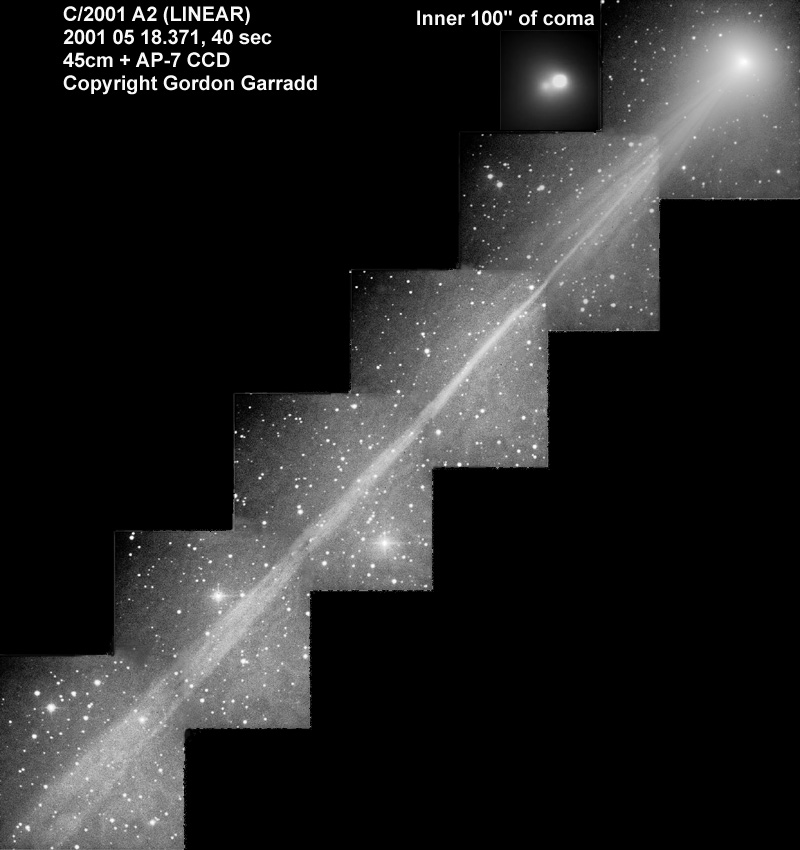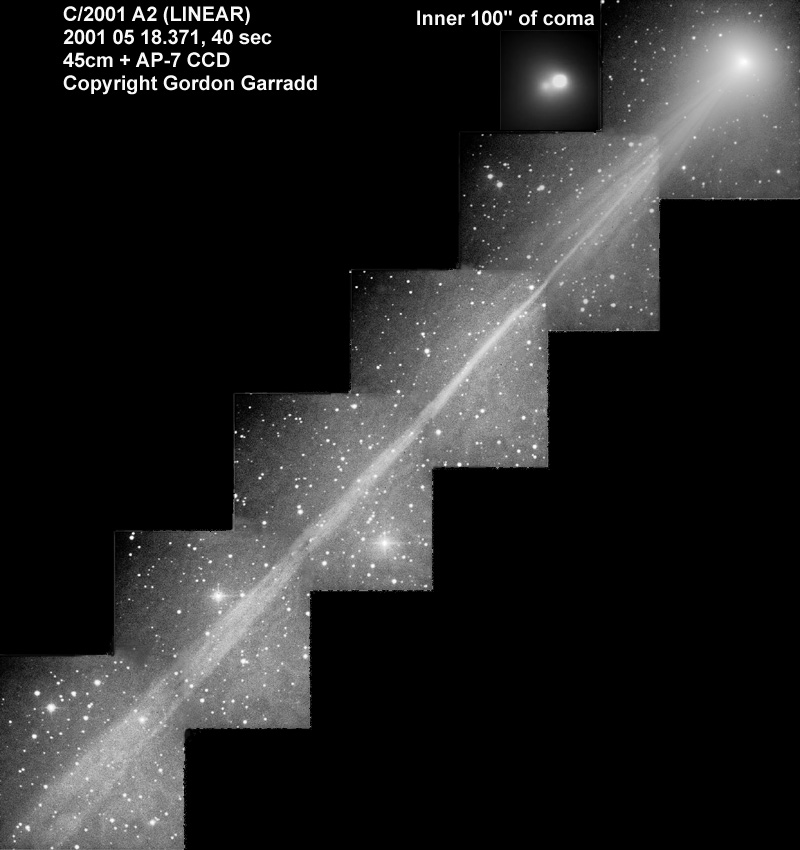
Arcing toward southern skies in late March, this faint comet LINEAR - the one officially designated C/2001 A2 (LINEAR) - brightened unexpectedly. The outburst, apparently due to the fragmentation of its nucleus, delighted observers as the comet eventually increased to naked-eye brightness. Comet LINEAR's tail also grew and in this mosaic of images from May 18, astronomer Gordon Garradd has carefully followed the fluorescing filaments of LINEAR's gas tail stretching 1.5 degrees (the width of three full moons) along the anti-sunward direction. The inset close-up near the top clearly shows two bright condensations in the cometary coma, indicating the presence of a split nucleus. This comet LINEAR made its closest approach to the Sun on May 24. Still showing off for southern skygazers at about 5th magnitude, it will become more easily visible for northern observers by late June.
A mediados de marzo, esta tenue cometa LINEAR - oficialmente designada como C/2001 A2 (LINEAR) - brilló inesperadamente. El aumento de brillo, aparentemente debido a la fragmentación de su núcleo, deleitó a los observadores, ya que la cometa eventualmente alcanzó una magnitud visible a simple vista. La cola de la cometa LINEAR también creció, y en esta mosaico de imágenes del 18 de mayo, el astrónomo Gordon Garradd ha seguido cuidadosamente los filamentos fluorescentes de la cola de gas de LINEAR, que se extienden 1.5 grados (el ancho de tres lunas llenas) en la dirección opuesta al Sol. El recuadro de acercamiento cerca de la parte superior muestra claramente dos condensaciones brillantes en la coma comética, indicando la presencia de un núcleo dividido. Esta cometa LINEAR alcanzó su punto más cercano al Sol el 24 de mayo. Aún mostrando su esplendor para los observadores del hemisferio sur a unos 5 magnitudes, será más fácilmente visible para los observadores del hemisferio norte a finales de junio.