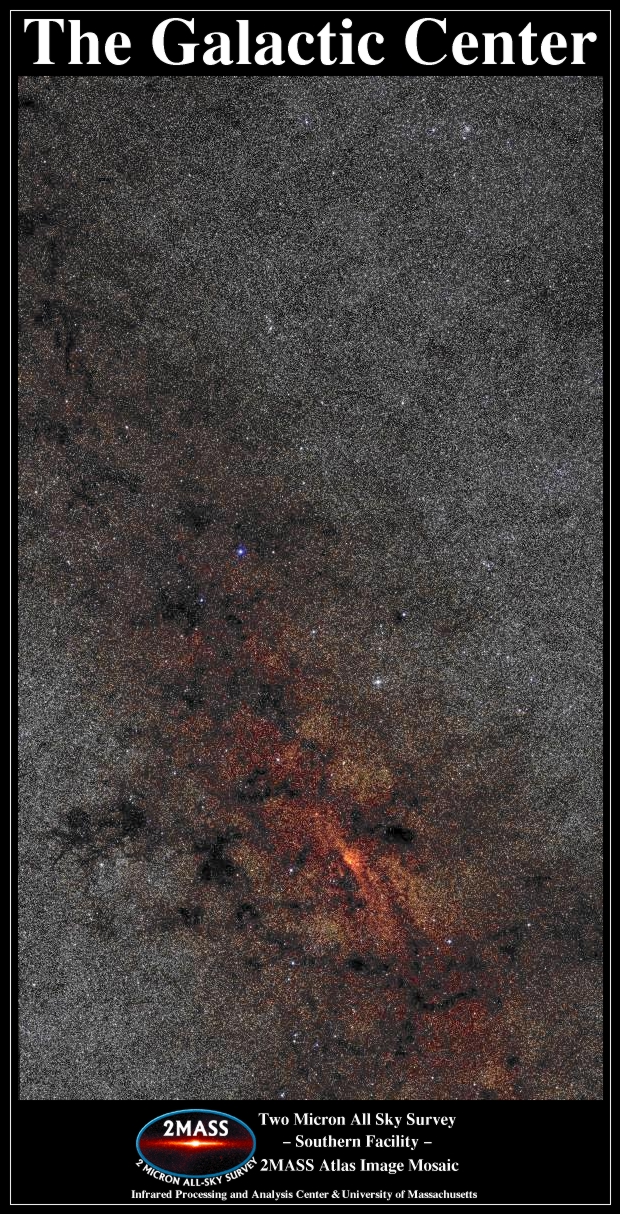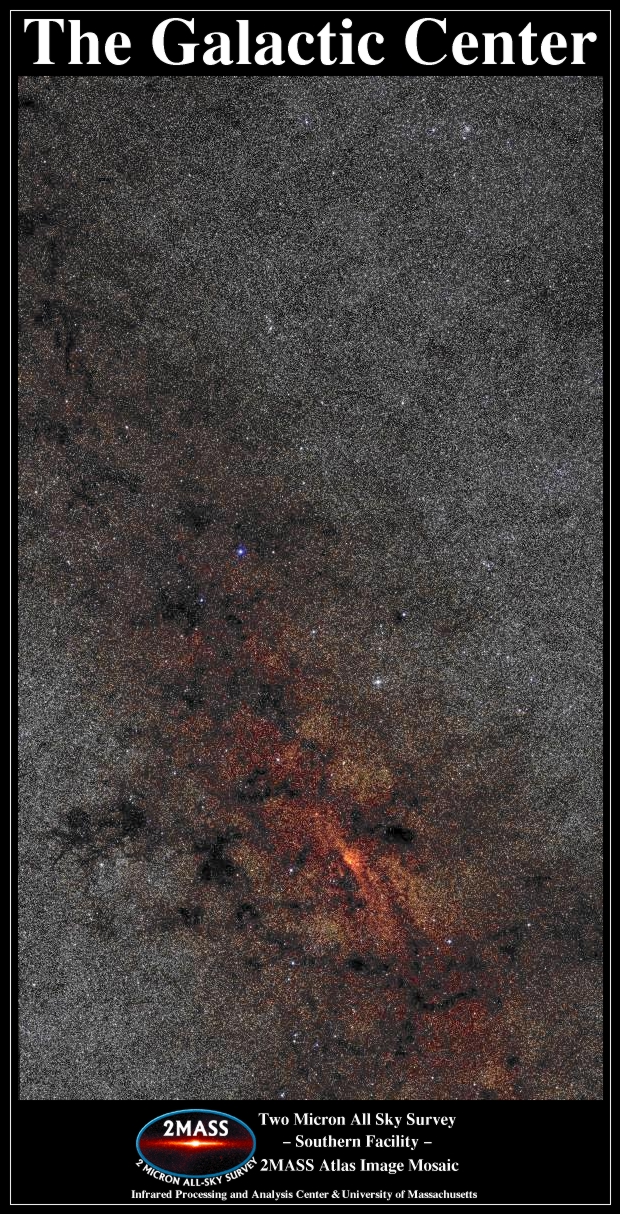
The center of our Galaxy is a busy place. In visible light, much of the Galactic Center is obscured by opaque dust. In infrared light, however, dust glows more and obscures less, allowing nearly one million stars to be recorded in the above photograph. The Galactic Center itself appears on the right and is located about 30,000 light years away towards the constellation of Sagittarius. The Galactic Plane of our Milky Way Galaxy, the plane in which the Sun orbits, is identifiable by the dark diagonal dust lane. The absorbing dust grains are created in the atmospheres of cool red-giant stars and grow in molecular clouds. The region directly surrounding the Galactic Center glows brightly in radio and high-energy radiation, and is thought to house a large black hole.
El centro de nuestra Galaxia es un lugar muy activo. En luz visible, gran parte del centro galáctico está oculto por polvo opaco. Sin embargo, en luz infrarroja, el polvo emite más radiación y oculta menos, permitiendo registrar casi un millón de estrellas en la fotografía de arriba. El propio centro galáctico aparece a la derecha y se encuentra a unos 30 000 años luz de distancia, en dirección a la constelación de Sagitario. El plano galáctico de nuestra Vía Láctea, el plano en el que orbita el Sol, es identificable por la banda diagonal oscura de polvo. Los granos absorbentes de polvo se forman en las atmósferas de estrellas gigantes rojas frías y crecen en nubes moleculares. La región directamente alrededor del centro galáctico emite brillantemente en radiación de radio y de alta energía, y se cree que alberga un agujero negro muy grande.