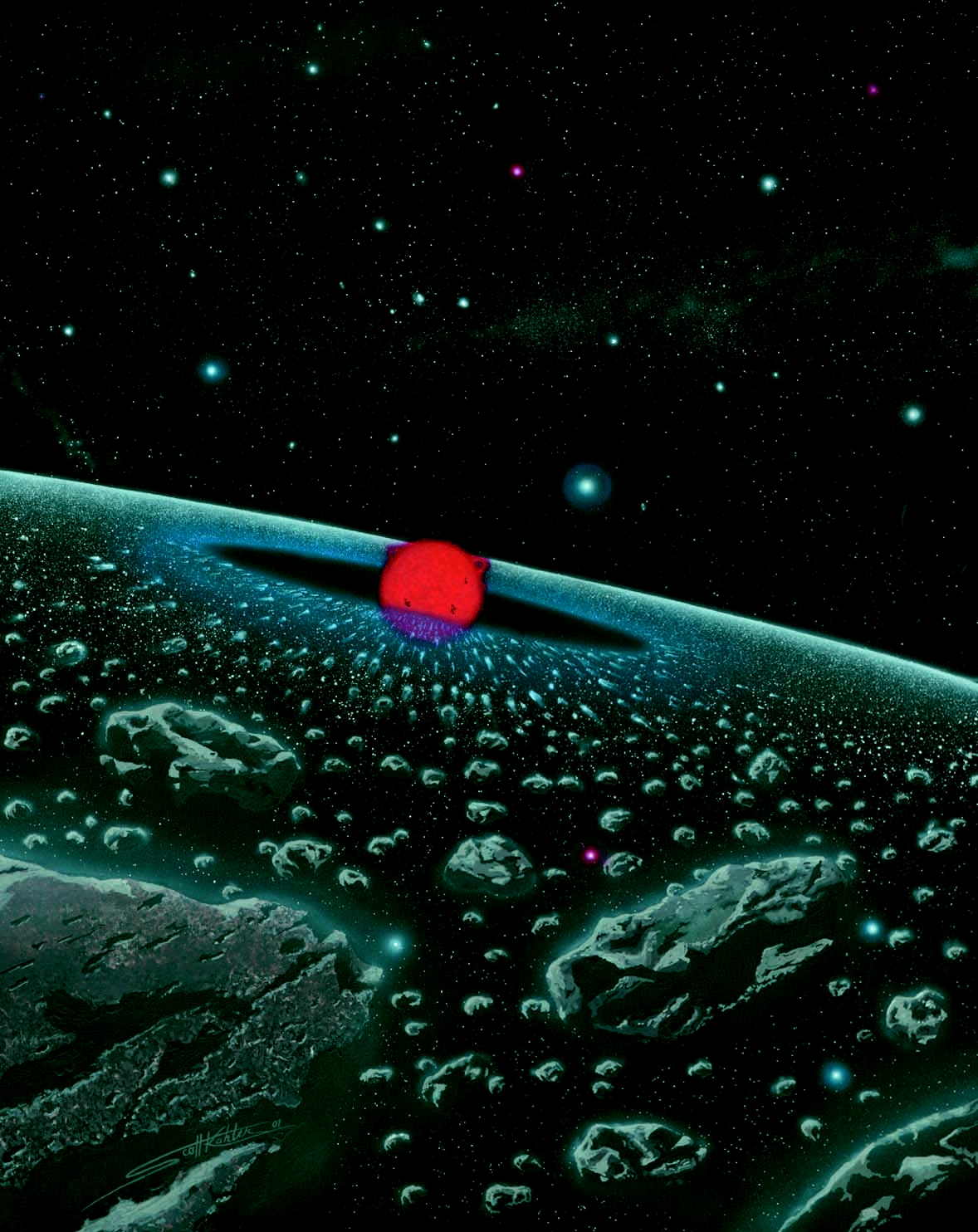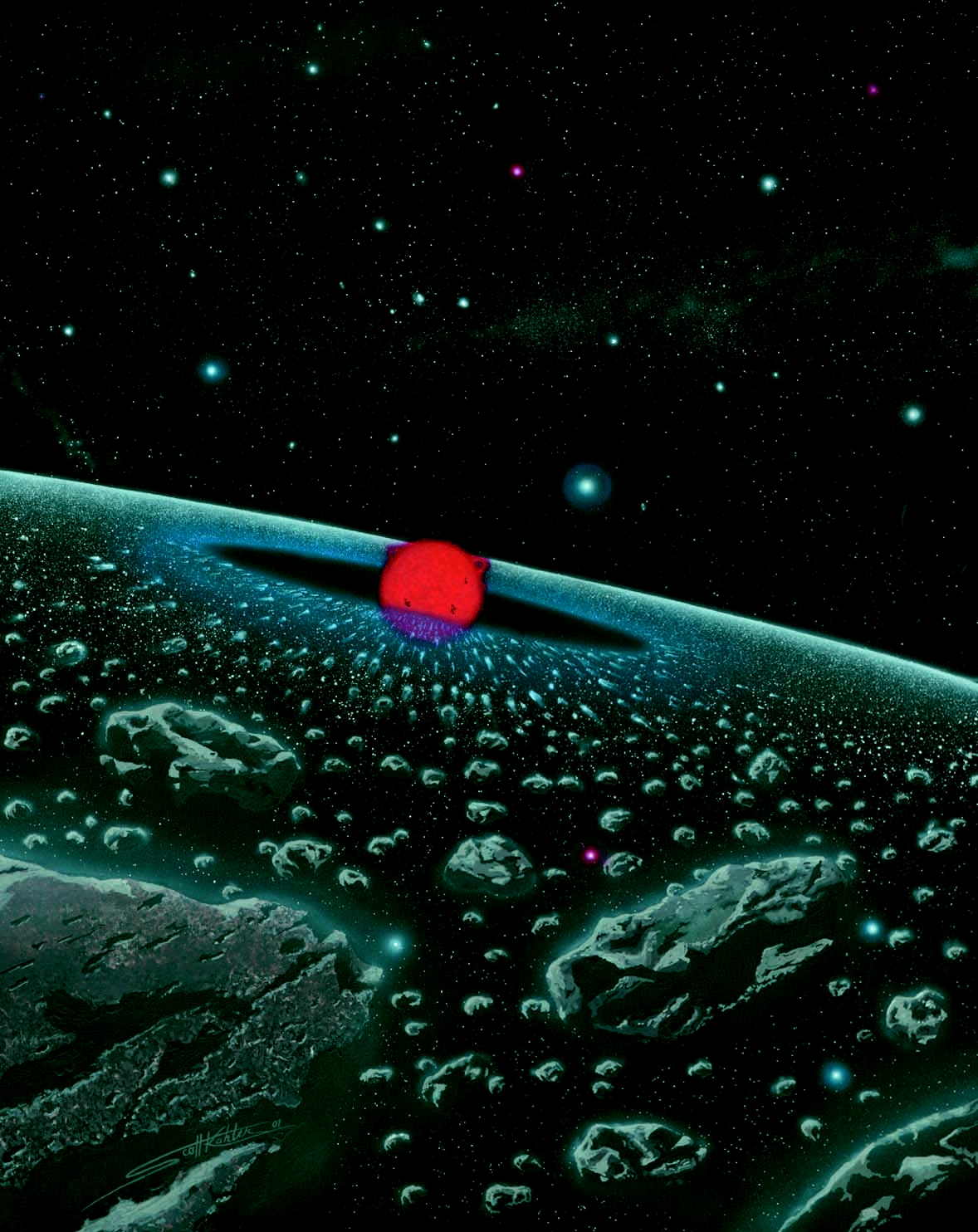
Do worlds outside our Solar System have oceans of water like Earth? An indication that such worlds might exist was bolstered recently by new evidence that nearby star system CW Leonis harbors water. Recent observations with the Submillimeter Wave Astronomy Satellite (SWAS) found significant detections of light at specific colors emitted by water. A hypothesis quickly arose that the activity of the central star is vaporizing water from a cloud of comets that surrounds the star -- a cloud that may be similar to the Kuiper Belt of comets that surrounds our own Sun. The above drawing depicts the CW Leonis system with its hypothesized cloud of water-bearing comets situated to a ring. The closest comets are depicted as showing tails rich in water vapor pointing away from the star. Far from the central star, however, comets should not show significant tails and should be more sparsely spaced. The central star, also known as IRC+10216, is an aging giant star located about 500 light-years away toward the constellation of Leo.
¿Tienen los mundos fuera de nuestro Sistema Solar océanos de agua como la Tierra? Una indicación de que tales mundos podrían existir se fortaleció recientemente con nueva evidencia de que el sistema estelar cercano CW Leonis alberga agua. Observaciones recientes con el Satélite de Astronomía en Ondas Submilimétricas (SWAS) detectaron significativamente luz en colores específicos emitidos por el agua. Rápidamente surgió una hipótesis de que la actividad de la estrella central está vaporizando agua de una nube de cometas que rodea a la estrella — una nube que podría ser similar al Cinturón de Kuiper de cometas que rodea a nuestro propio Sol. El dibujo de arriba representa el sistema CW Leonis con su hipotética nube de cometas portadores de agua situada en forma de anillo. Los cometas más cercanos se representan mostrando colas ricas en vapor de agua que apuntan alejándose de la estrella. Sin embargo, lejos de la estrella central, los cometas no deberían mostrar colas significativas y deberían estar más dispersos. La estrella central, también conocida como IRC+10216, es una estrella gigante envejecida ubicada a unos 500 años luz de distancia hacia la constelación de Leo.