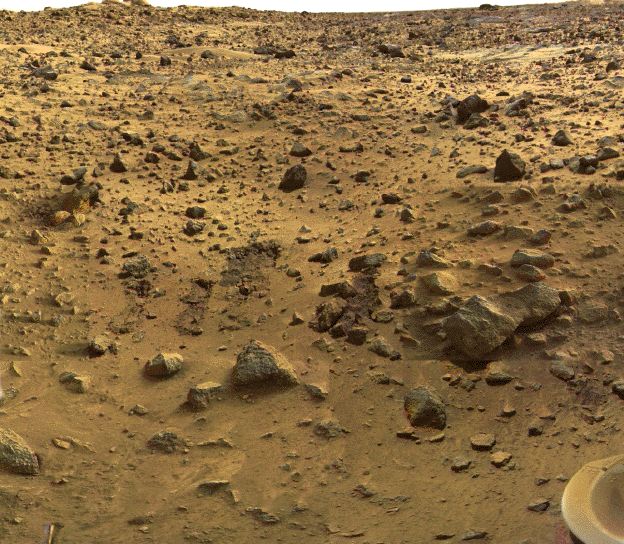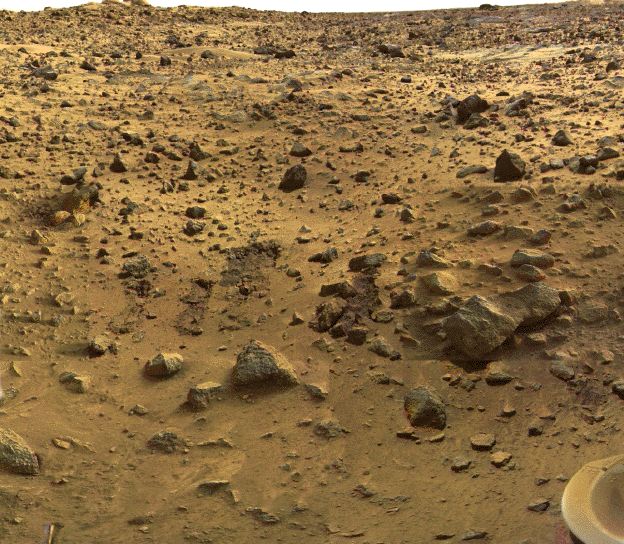
On July 20, 1976, NASA's Viking 1 lander became the first U.S. spacecraft to land on Mars, followed weeks later by its twin robot explorer, the Viking 2 lander. Operating on the Martian surface into the early 1980s, the Vikings took thousands of pictures, conducted sophisticated chemical searches for life, and studied the martian weather and geology. In the dramatically detailed image above, a field of rocks and boulders is viewed from the Viking 1 landing site on Chryse Planitia (the Plain of Chryse). Viking 1's dusty foot pad is just visible at the lower right. The image was created by combining high resolution black and white images with lower resolution color images of the same area. NASA is continuing its well chronicled martian exploration program as the Mars Odyssey spacecraft is scheduled to arrive at the mysterious Red Planet on October 24th. What's Mars like today?
El 20 de julio de 1976, el módulo de aterrizaje Viking 1 de la NASA se convirtió en la primera nave espacial estadounidense en aterrizar en Marte, seguida semanas después por su gemela, la exploradora robótica Viking 2. Operando en la superficie marciana hasta principios de los años 80, los Viking tomaron miles de imágenes, realizaron búsquedas químicas sofisticadas de vida y estudiaron el clima y la geología marcianos. En la imagen detallada y dramáticamente presentada arriba, se observa un campo de rocas y bloques desde el lugar de aterrizaje de Viking 1 en Chryse Planitia (el llano de Chryse). Justo visible en la parte inferior derecha se encuentra la suela polvorienta de Viking 1. La imagen fue creada combinando imágenes en blanco y negro de alta resolución con imágenes en color de menor resolución del mismo área. La NASA continúa su bien documentado programa de exploración marciana, ya que la nave espacial Mars Odyssey está programada para llegar al misterioso Planeta Rojo el 24 de octubre. ¿Cómo es Marte hoy en día?