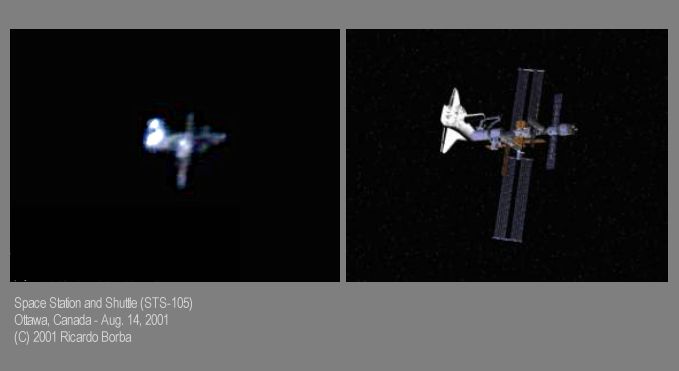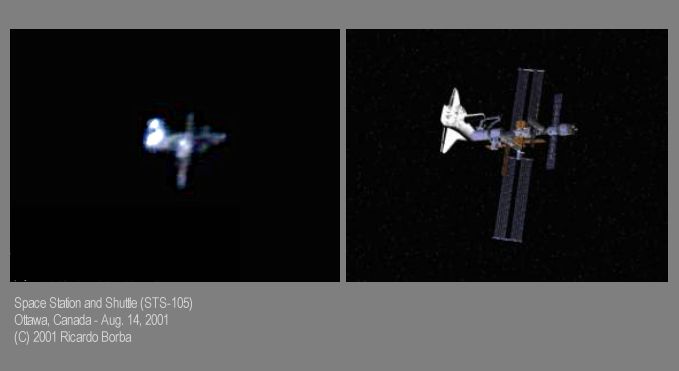
Knowing when and where to look, many enthusiastic sky gazers have been able to spot the International Space Station (ISS) as a bright star streaking through the twilight. But with a digital camera and a small telescope, recognizable images are possible too. Astronomer Ricardo Borba offers this example of the Space Shuttle Discovery docked with the ISS, recorded this August from his backyard in Ottawa, Canada. Operating a digital video camera on an 8 inch reflecting telescope, Borba tracked the Earth-orbiting pair by hand. Unwanted telescope motion and atmospheric blurring caused most of the video frames to be indistinct, still the single best frame (left) from his video sequence is amazingly sharp. For comparison, he constructed a computer generated image (right) showing the approximate orientation of the Shuttle/ISS docking configuration based on virtual 3D models available on the web.
Sabiendo cuándo y dónde mirar, muchos entusiastas observadores del cielo han podido localizar la Estación Espacial Internacional (ISS) como una estrella brillante que cruza el crepúsculo. Pero con una cámara digital y un pequeño telescopio, también es posible obtener imágenes reconocibles. El astrónomo Ricardo Borba ofrece este ejemplo del Transbordador Espacial Discovery acoplado a la ISS, grabado este agosto desde su jardín en Ottawa, Canadá. Operando una cámara de video digital montada en un telescopio reflector de 8 pulgadas, Borba siguió a la pareja en órbita terrestre a mano. El movimiento no deseado del telescopio y el desenfoque atmosférico hicieron que la mayoría de los fotogramas del video fueran indistintos, sin embargo, el mejor fotograma (izquierda) de su secuencia de video resultó asombrosamente nítido. Para comparación, construyó una imagen generada por computadora (derecha) que muestra la orientación aproximada de la configuración de acoplamiento del Transbordador/ISS, basada en modelos 3D virtuales disponibles en Internet.