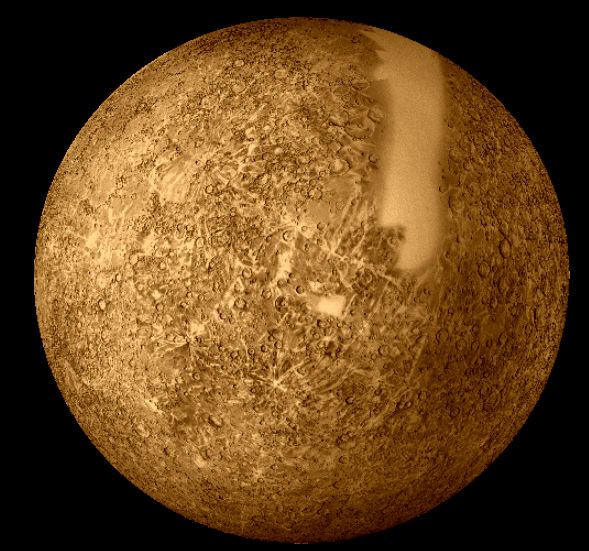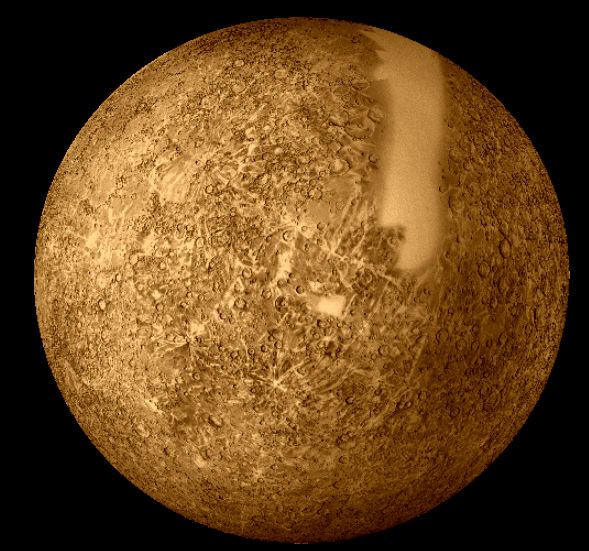
Mercury, the closest planet to the Sun, remains the most mysterious of the Solar System's inner planets. Hiding in the Sun's glare it is a difficult target for Earth bound observers. The only spacecraft to explore Mercury close-up was Mariner 10 which executed three flybys of Mercury in 1974 and 1975, surveying approximately 45 percent of its surface. Mariner 10 deftly manuevered to photograph part of the sunlit hemisphere during each approach, passed behind the planet, and continued to image the sun-facing side as the spacecraft receded. Its highest resolution photographs recorded features approximately a mile across. A reprocessing of the Mariner 10 data has resulted in this dramatic mosaic. Like the Earth's Moon, Mercury's surface shows the scars of impact cratering - the smooth vertical band and patches visible above represent regions where no image information is available.
Mercurio, el planeta más cercano al Sol, sigue siendo el más misterioso de los planetas interiores del Sistema Solar. Al esconderse tras el resplandor solar, resulta un objetivo difícil para los observadores terrestres. La única nave espacial que exploró Mercurio de cerca fue Mariner 10, que realizó tres sobrevuelos del planeta en 1974 y 1975, mapeando aproximadamente el 45 por ciento de su superficie. Mariner 10 maniobró con precisión para fotografiar parte del hemisferio iluminado durante cada acercamiento, pasó detrás del planeta y continuó tomando imágenes del lado que mira al Sol a medida que la nave se alejaba. Sus fotografías de mayor resolución registraron características de aproximadamente un kilómetro de ancho. Un nuevo procesamiento de los datos de Mariner 10 ha resultado en esta mosaico impactante. Al igual que la superficie de la Luna terrestre, la de Mercurio muestra las marcas de la meteorización por impactos — la banda vertical lisa y las manchas visibles arriba representan regiones donde no hay información de imagen disponible.