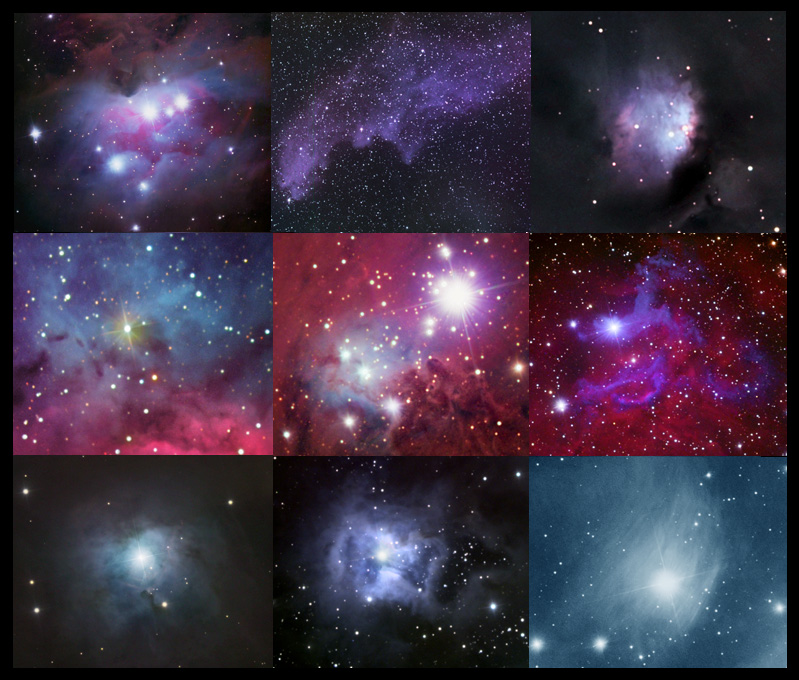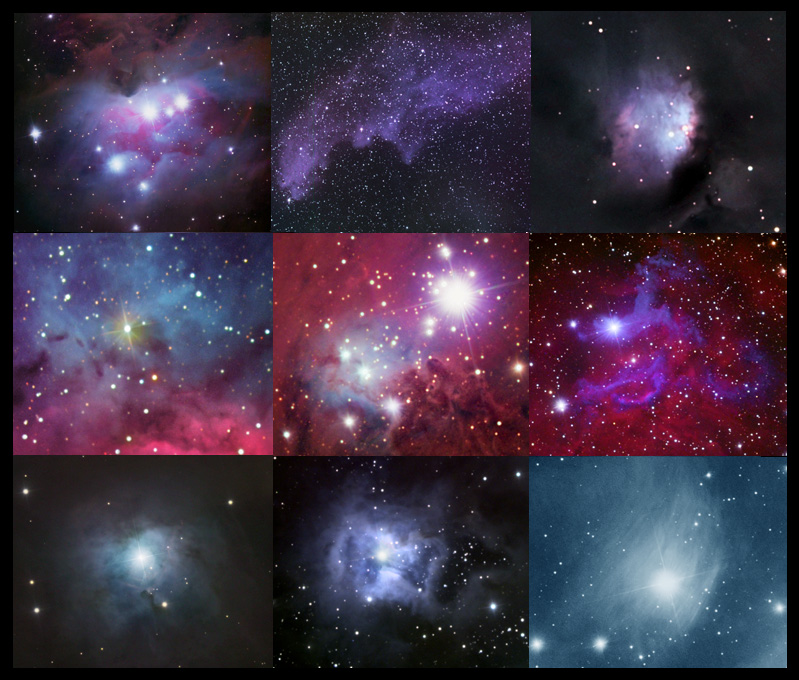
Interstellar dust grains often find themselves in a reflective "mood". Near a bright star, clouds of these dust particles scatter short wavelengths of visible starlight more readily than long wavelengths, producing lovely blue reflection nebulae. Nine of the more spectacular examples of these dusty, blue stellar neighborhoods have been assembled here by astrophotographer Rob Gendler. From left to right starting with the top row are NGC 1977 in Orion, IC2118 (the Witch Head), and M78 also in Orion. Across the middle row are, M20 (Trifid), NGC 2264 in Monoceros, and IC405 (Flaming Star Nebula). Along the bottom are NGC 2023 (near the Horsehead), NGC 7023 (Iris Nebula), and finally bright star Merope surrounded by a veil of dust (NGC 1435). Merope is one of the seven sisters of the Pleiades.
Las partículas de polvo interestelar a menudo se encuentran en un estado "reflexivo". Cerca de una estrella brillante, las nubes de estos granos de polvo dispersan con mayor facilidad las longitudes de onda cortas de la luz visible estelar que las longitudes de onda largas, produciendo hermosas nebulosas de reflexión azul. Aquí, el astrógrafo Rob Gendler ha reunido nueve ejemplos espectaculares de estos vecindarios estelares azules y polvorientos. De izquierda a derecha, comenzando por la fila superior, se encuentran NGC 1977 en Orión, IC2118 (la Cabeza de Bruja) y M78 también en Orión. En la fila central están M20 (Trifid), NGC 2264 en Monoceros y IC405 (la Nebulosa de la Estrella en Llamas). A lo largo de la fila inferior se encuentran NGC 2023 (cerca de la Cabellera de Caballo), NGC 7023 (la Nebulosa Iris) y finalmente la brillante estrella Merope rodeada por un velo de polvo (NGC 1435). Merope es una de las siete hermanas de las Pléyades.