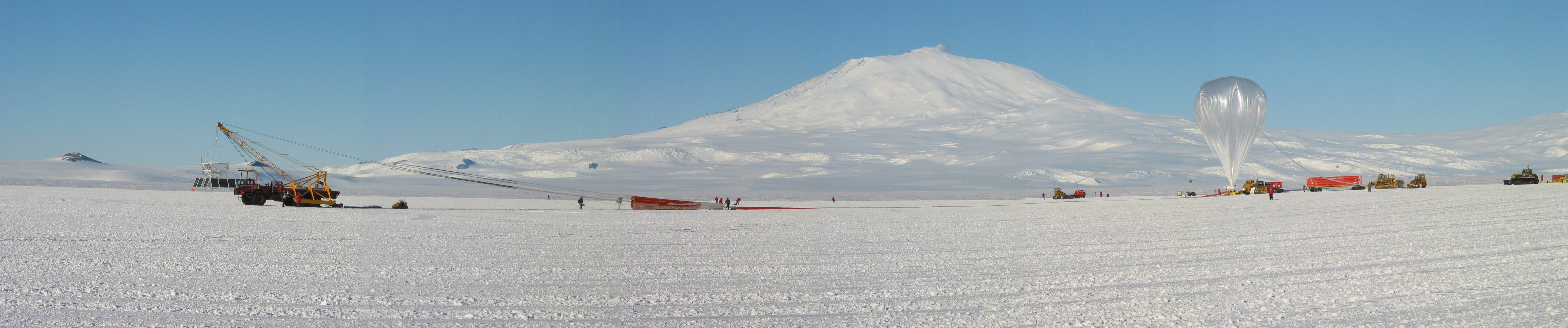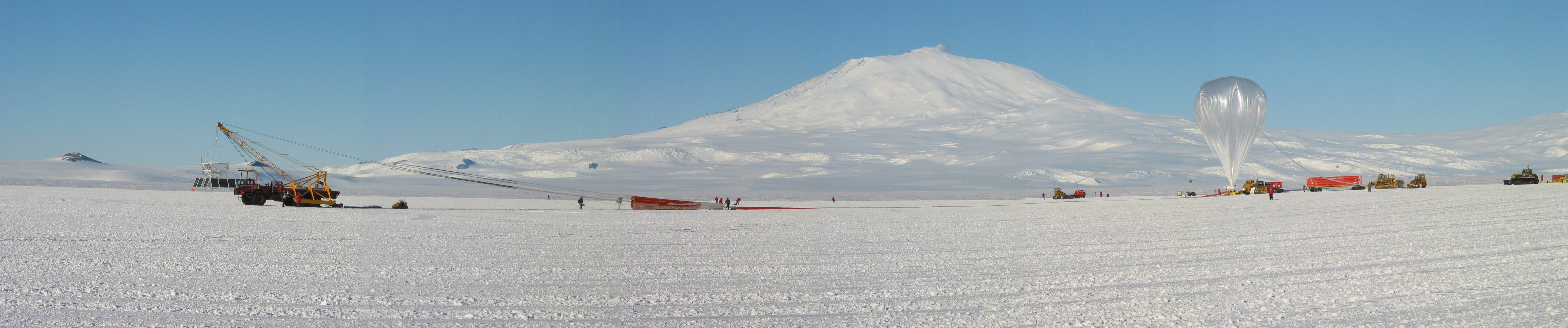
Where does a two-ton tiger hang out? Well, in this case the Trans-Iron Galactic Element Recorder (TIGER) experiment hangs from a mobile crane on the far left in this panorama photo recorded last December near McMurdo Station, Antarctica. The helium-filled balloon which carried TIGER aloft for a record setting 31+ days is stretched out far to the right (scroll right) against the background of majestic Mt. Erebus, the southernmost active volcano in the world. While cruising with its two-ton payload above 100,000 feet, the scientific balloon's fully inflated internal volume was roughly the same as the Louisiana Superdome, but its walls were as thin as shrinkwrap. TIGER was designed to detect the unexplained galactic cosmic rays -- atomic nuclei moving at near light-speed which impinge on the Earth from outside our Solar System. By making the first sensitive measurements of cosmic rays with atomic numbers between 26 (Iron) and 40 (Zirconium), TIGER investigators will seek to identify the type of astrophysical environments which could be sources of the galactic cosmic-ray material and possible ways in which the nuclei are accelerated to such high speeds.
¿Dónde se cuelga un tigre de dos toneladas? Bueno, en este caso el experimento Trans-Iron Galactic Element Recorder (TIGER) cuelga de una grúa móvil en el extremo izquierdo de esta foto panorámica tomada el pasado diciembre cerca de la Estación McMurdo, Antártida. El globo lleno de helio que llevó a TIGER a gran altura durante un récord de más de 31 días se extiende hacia la derecha (desplazarse a la derecha) contra el fondo del majestuoso Monte Erebus, el volcán activo más meridional del mundo. Mientras navegaba con su carga útil de dos toneladas a más de 100.000 pies de altitud, el volumen interno completamente inflado del globo científico era aproximadamente el mismo que el del Superdomo de Luisiana, pero sus paredes eran tan delgadas como el plástico de envase. TIGER fue diseñado para detectar los rayos cósmicos galácticos inexplicables —núcleos atómicos que se mueven a velocidades cercanas a la de la luz que inciden en la Tierra desde fuera de nuestro Sistema Solar. Al hacer las primeras mediciones sensibles de rayos cósmicos con números atómicos entre 26 (hierro) y 40 (circonio), los investigadores de TIGER buscarán identificar el tipo de ambientes astrofísicos que podrían ser fuentes del material de rayos cósmicos galácticos y las posibles formas en que los núcleos se aceleran a tales velocidades tan altas.