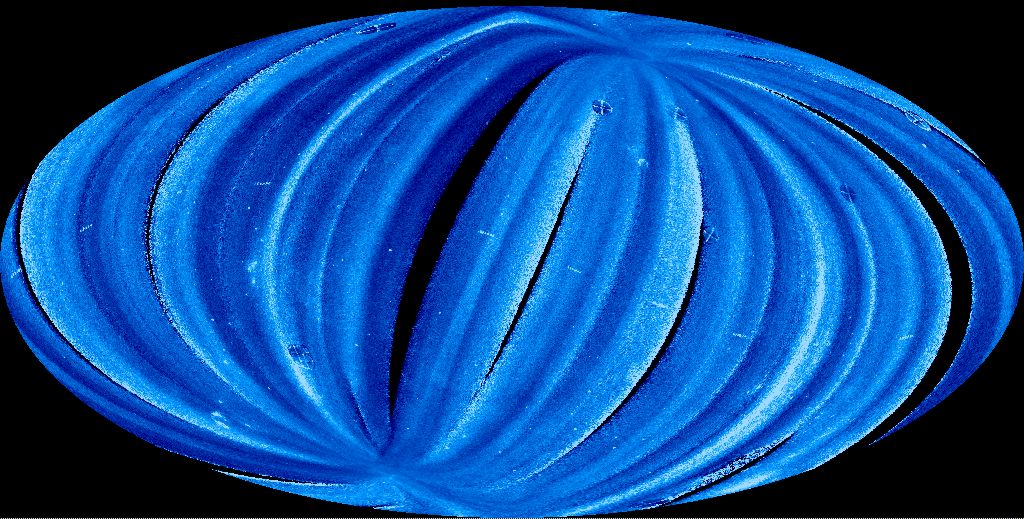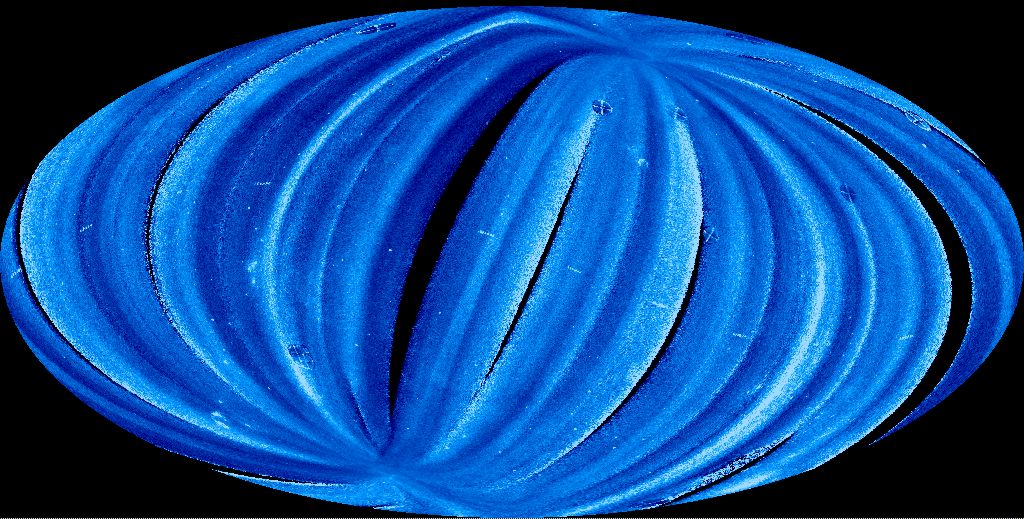
The stars beyond the Sun and the distant galaxies should be undetectable at extreme ultraviolet wavelengths. At least that was the conventional wisdom when it was first realized that the space between the stars is filled with hydrogen, a strong absorber of extreme ultraviolet light. But this idea was seriously questioned as it became apparent that interstellar hydrogen was patchy in its distribution and the quest to explore the extreme ultraviolet sky culminated in 1992 with the launch of the EUVE (Extreme UltraViolet Explorer) spacecraft. An all-sky map, based on the satellite's first six months of operation, appears above showing brightness variations in the EUV sky in false color (north is up). EUVE's scanning by orbit gives the picture a striped look while other instrument artifacts are seen as crosses and data gaps are dark. Multiple images of the Moon combine to form the short, bright dashed lines wandering along the middle of the picture. The belt stars of the familiar constellation Orion are fairly easy to make out left of picture center. EUVE's science operations ceased in 2001 but it ultimately detected nearly 1,000 celestial objects, including over three dozen outside our own galaxy. EUVE's voyage of discovery is now complete, and the spacecraft re-entered the Earth's atmosphere yesterday at approximately 11:15 p.m. EST.
Se suponía que las estrellas más allá del Sol y las galaxias distantes serían indetectables en longitudes de onda ultravioleta extrema. Al menos esa era la sabiduría convencional cuando se comprendió por primera vez que el espacio entre las estrellas está lleno de hidrógeno, un fuerte absorbente de luz ultravioleta extrema. Sin embargo, esta idea fue cuestionada seriamente cuando se hizo evidente que el hidrógeno interestelar tenía una distribución irregular, y la búsqueda para explorar el cielo ultravioleta extremo culminó en 1992 con el lanzamiento del satélite EUVE (Explorador de Ultravioleta Extremo). Un mapa de todo el cielo, basado en los primeros seis meses de operación del satélite, aparece arriba mostrando variaciones de brillo en el cielo EUV en falso color (el norte está hacia arriba). El barrido orbital de EUVE le da a la imagen un aspecto rayado, mientras que otros artefactos instrumentales se ven como cruces y las brechas de datos aparecen oscuras. Múltiples imágenes de la Luna se combinan para formar las líneas discontinuas cortas y brillantes que serpentean a lo largo del centro de la imagen. Las estrellas del cinturón de la constelación familiar de Orión son bastante fáciles de identificar a la izquierda del centro de la imagen. Las operaciones científicas de EUVE cesaron en 2001, pero finalmente detectó casi 1.000 objetos celestes, incluidos más de tres docenas fuera de nuestra propia galaxia. El viaje de descubrimiento de EUVE ha concluido, y la nave se reentró en la atmósfera terrestre ayer aproximadamente a las 11:15 p.m. EST.