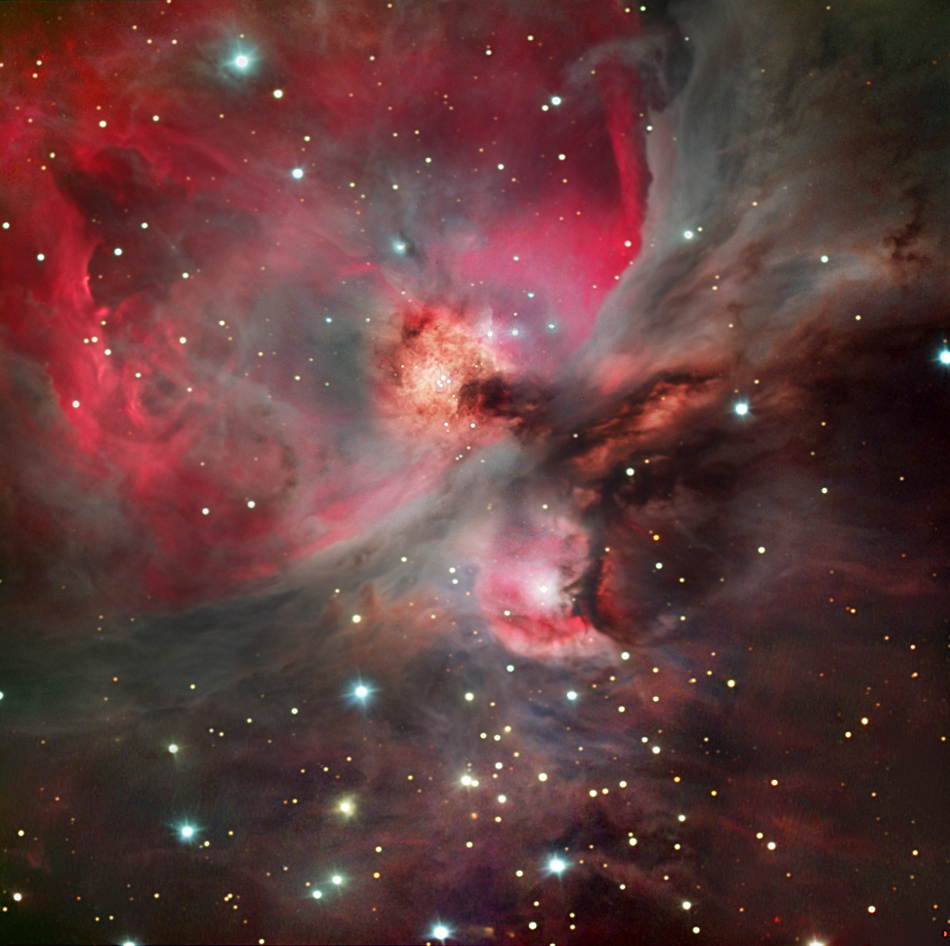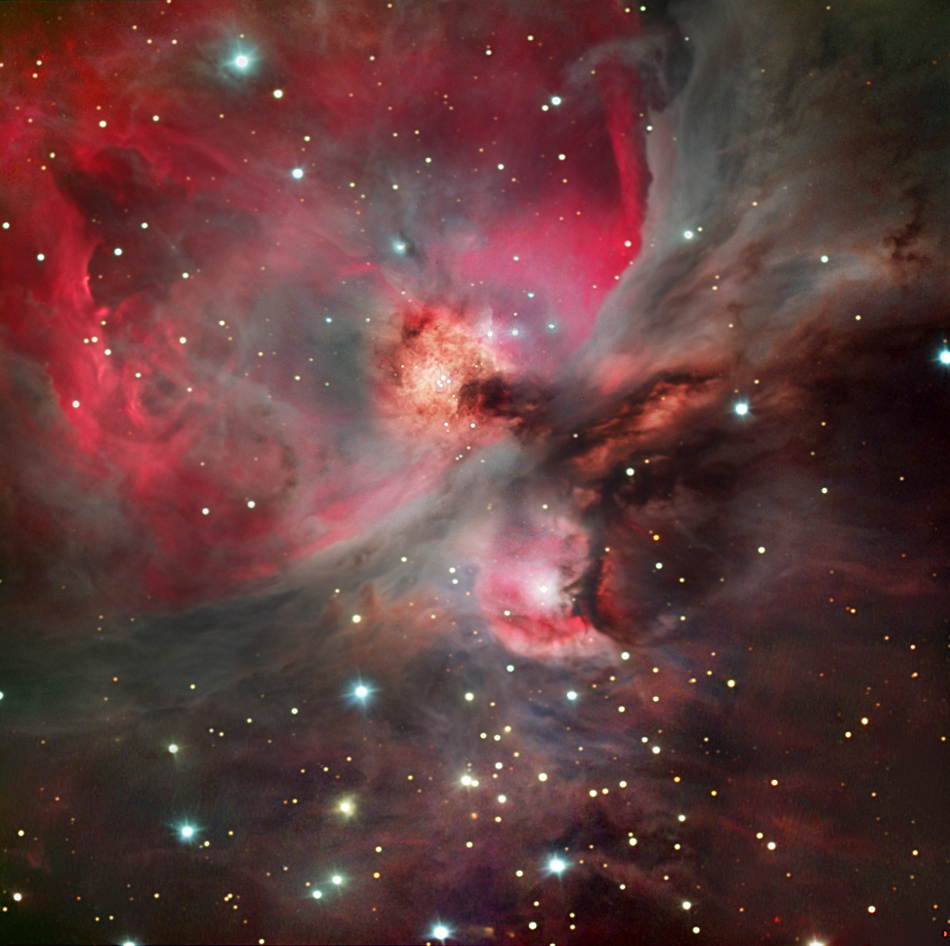
Few astronomical sights excite the imagination like the nearby stellar nursery known as the Orion Nebula. The Nebula's glowing gas surrounds hot young stars at the edge of an immense interstellar molecular cloud only 1500 light-years away. The Great Nebula in Orion can be found with the unaided eye just below and to the left of the easily identifiable belt of three stars in the popular constellation Orion. The above image has been contrast balanced to bring out Orion's detail in spectacular fashion. Visible simultaneously are the bright stars of the Trapezium in Orion's heart, the sweeping lanes of dark dust that cross the center, the pervasive red glowing hydrogen gas, and the blue tinted dust that reflects the light of newborn stars. The whole Orion Nebula cloud complex, which includes the Horsehead Nebula, will slowly disperse over the next 100,000 years.
Pocos espectáculos astronómicos cautivan la imaginación como la guardería estelar cercana conocida como la Nebulosa de Orión. El gas brillante de la nebulosa rodea estrellas jóvenes calientes en el borde de una inmensa nube molecular interestelar a solo 1500 años luz de distancia. La Gran Nebulosa de Orión puede encontrarse a simple vista justo debajo y a la izquierda del fácilmente identificable cinturón de tres estrellas en la popular constelación de Orión. La imagen anterior ha sido equilibrada en contraste para resaltar los detalles de Orión de manera espectacular. Simultáneamente son visibles las brillantes estrellas del Trapecio en el corazón de Orión, los amplios carriles de polvo oscuro que cruzan el centro, el omnipresente gas de hidrógeno que brilla en rojo, y el polvo teñido de azul que refleja la luz de estrellas recién nacidas. El complejo nuboso de toda la Nebulosa de Orión, que incluye la Nebulosa de la Cabeza de Caballo, se dispersará lentamente durante los próximos 100 000 años.